Steph, please watch this video.. Around 2:13, there is a movement much like the one i think a baby would have when its in the womb.
http://www.youtube.com/watch?v=V4iogpRC25s&feature=related
Will try to get you more.
-Priscilla
Monday, April 19, 2010

Tuesday, April 6, 2010
Muichoo's CHINESE OPERA
Chinese Opera elements that I will be adding:
-MOVEMENT
1. Small steps all the time.
2. Hands gestures (you know the conventional way of putting your hand in an awkward position during performance all the time??)
3. During my monologue, my movements will be even more exaggerated into Chinese Opera style.
-SPEECH/VOICE
1. I tend to lengthen my way of speaking but people must always remind me (esp. Sarah) to talk faster. (Or else the play will be too long!)
2. My voice will be of a higher pitch than everyone else except maybe for Guak when she shrieks.
2. During my monologue, can I possibly.. sing? In Chinese Opera style?
MY CHINESE OPERA CHARACTER: It's difficult to choose between Qingyi & Huadan!!! I've got a social status of Huadan but movements and thinking of a Qingyi! Can I possibly be Huashan? Read on.
QINGYI VS HUADAN
(things that match will be in blue & things that don't match will be in red)
Qing Yi actress portrays a lady of good and sympathetic character. Usually of a quiet, gentle disposition and graceful in her movements, she is the Chinese ideal of a beautiful woman. As a wife she is faithful, as a young girl a model of propriety. Her good breeding is shown by the graceful, flowing movements of her 'water sleeves'. The Qing Yi's costume is elegant, simple and of good quality, but not as vivid in color as that of the Hua Dan. Her singing is of a pure, high-pitched quality.
For a Hua Dan actress the gay, flirtatious personality of a young girl is required. Usually not of such a high social standing as the Qing Yi, the Hua Dan actress with her coy, coquettish and generally quicker movements arrests the attention of the audience. This is a difficult part to play successfully. The Hua Dan's facial expression is continually changing and her mischievous eye movements are particularly attractive. Because of her lower social status more hand movements are required, as in olden times it was not considered polite for a well-bred Chinese lady to show her hands. Costume, usually vivid in design and color, consists of a jacket and trousers, and a red or coloews handkerchief is carried to flutter in the actress's hand. Her character, needless to say, is not as virtuous as that of the Qing Yi and therefore her singing voice has a gayer and slightly stronger quality. She also has to do more speaking than singing.
A Gui Men Dan is the young, unmarried girl, who in later life will develop into a Qing Yi or a Hua Dan; her immaturity is clearly shown in her reactions, for though naughty and slightly mischievous, she has not the confidence of the Hua Dan, although her schemes and plans are often just as successful.
From http://www.chinahighlights.com/travelguide/beijing-opera/roles.htm#dan
5)Dan
The Dan (旦) refers to any female role in Beijing opera. Dan roles were originally divided into five subtypes. Old women were played by laodan, martial women were wudan, young female warriors were daomadan, virtuous and elite women were qingyi, and vivacious and unmarried women were huadan.
One of Mei Lanfang’s most
important contributions to Beijing opera was in pioneering a sixth type of role, the huashan. This role type combines the status of the qingyi with the sensuality of the huadan.
(another version) This role type combines the nobility and grace of the “qingyi” with the flirtatious, extrovert characteristics of the “huadan.”
This website shows Traditional Meets Experimental--Modernizing Peking Opera on the Mainland :
http://www.sinorama.com.tw/en/show_issue.php?id=199678507050E.TXT&table=2&h1=Art+and+Culture&h2=Traditional+Opera
-MOVEMENT
1. Small steps all the time.
2. Hands gestures (you know the conventional way of putting your hand in an awkward position during performance all the time??)
3. During my monologue, my movements will be even more exaggerated into Chinese Opera style.
-SPEECH/VOICE
1. I tend to lengthen my way of speaking but people must always remind me (esp. Sarah) to talk faster. (Or else the play will be too long!)
2. My voice will be of a higher pitch than everyone else except maybe for Guak when she shrieks.
2. During my monologue, can I possibly.. sing? In Chinese Opera style?
MY CHINESE OPERA CHARACTER: It's difficult to choose between Qingyi & Huadan!!! I've got a social status of Huadan but movements and thinking of a Qingyi! Can I possibly be Huashan? Read on.
QINGYI VS HUADAN
(things that match will be in blue & things that don't match will be in red)
Qing Yi actress portrays a lady of good and sympathetic character. Usually of a quiet, gentle disposition and graceful in her movements, she is the Chinese ideal of a beautiful woman. As a wife she is faithful, as a young girl a model of propriety. Her good breeding is shown by the graceful, flowing movements of her 'water sleeves'. The Qing Yi's costume is elegant, simple and of good quality, but not as vivid in color as that of the Hua Dan. Her singing is of a pure, high-pitched quality.
For a Hua Dan actress the gay, flirtatious personality of a young girl is required. Usually not of such a high social standing as the Qing Yi, the Hua Dan actress with her coy, coquettish and generally quicker movements arrests the attention of the audience. This is a difficult part to play successfully. The Hua Dan's facial expression is continually changing and her mischievous eye movements are particularly attractive. Because of her lower social status more hand movements are required, as in olden times it was not considered polite for a well-bred Chinese lady to show her hands. Costume, usually vivid in design and color, consists of a jacket and trousers, and a red or coloews handkerchief is carried to flutter in the actress's hand. Her character, needless to say, is not as virtuous as that of the Qing Yi and therefore her singing voice has a gayer and slightly stronger quality. She also has to do more speaking than singing.
A Gui Men Dan is the young, unmarried girl, who in later life will develop into a Qing Yi or a Hua Dan; her immaturity is clearly shown in her reactions, for though naughty and slightly mischievous, she has not the confidence of the Hua Dan, although her schemes and plans are often just as successful.
From http://www.chinahighlights.com/travelguide/beijing-opera/roles.htm#dan
5)Dan
The Dan (旦) refers to any female role in Beijing opera. Dan roles were originally divided into five subtypes. Old women were played by laodan, martial women were wudan, young female warriors were daomadan, virtuous and elite women were qingyi, and vivacious and unmarried women were huadan.
One of Mei Lanfang’s most
important contributions to Beijing opera was in pioneering a sixth type of role, the huashan. This role type combines the status of the qingyi with the sensuality of the huadan.
(another version) This role type combines the nobility and grace of the “qingyi” with the flirtatious, extrovert characteristics of the “huadan.”
This website shows Traditional Meets Experimental--Modernizing Peking Opera on the Mainland :
http://www.sinorama.com.tw/en/show_issue.php?id=199678507050E.TXT&table=2&h1=Art+and+Culture&h2=Traditional+Opera
Monday, April 5, 2010
Gwak's VITAL INFORMATION
1) Info about the time period you come from- significant events, location, food, culture, style, 'in' things, 'hot topics of duscussion'. Do the Stanislavski BEFORE STORY thing.
The period that Gwakawakaweena came from is in the 1980s-1990s, I will focus on the arts scene as it is pertinent to Gwak’s dream to be an artist.
Fact number 2: Within the community, art still doesn’t make business sense and maybe it’s not supposed to. Many aspiring artists have baskets full of unfulfilled dreams. Artists tend to be more cautious of boundaries and offending the status quo.
5) Go through the script and check to see-
(i) There is a constant type of voice for your character- Eg- Eng E Shen's voice
(ii) IS your characters realization caused directly/indirectly by Sarah? (It has to be)
Yes. Sarah is the one who drives Gwak past her façade and puts Gwak in her place. She makes Gwak see that the reality that she has created for herself is just an illusion and that she should move on. Sarah tells Gwak that there is more than this non-existence and that she can move on.
(iv) Check if regret is seen in ALL the scenes you are in (Make sure its not too obviously stated)
Sunday, April 4, 2010
Muichoo's Vital Information
Muichoo's Vital Information
1) Time Period - 1960s, Singapore.
In the 1960s, Singapore was a third world country with a GNP per capita of less than US$320. Infrastructure was poor, there was little capital; the handful of industries produced only for domestic consumption. Low-end commerce was the mainstay of the economy, and there was little or no direct foreign investment. There was massive unemployment and labour unrest following the withdrawal of the British troops. Creating jobs was the priority, and this meant attracting labour-intensive industries.
See more from: "http://www.sedb.com/edb/sg/en_uk/index/about_edb/our_history/the_1960s.html"
The year was 1967, and Singapore started to print its own currency and made national service a compulsory thing for all young Singaporean men of lawful age. It was the year where fake eyelashes were rented out for S$4 per day; and prices of eggs plummeted to a new low that drove Singaporeans to form a lobby group on “chicken butchery” in order to reduce the supply of eggs. In the same year, “Vietnamese Rose” - a form of syphilis – came into Singapore and men who called on prostitutes shuddered at the mere mention of the name; It was also the year when Sakura and Rita Chao’s “New Peach-blossom River” was all the rage in the streets of Singapore.
See more from: "http://together.mediacorptv.sg/channel_8_drama_together_about.htm"
2) Role in the society - Disgraced outcast
All performers at that time is considered as low-status jobs. People were conservative at that time and find that performers often need to provide special services to people to get famous. Hence, many have the perception that they're ''dirty workers'', especially for the female. No matter how unpopular the job is, the pay is still good enough for people to want that job.
Muichoo is a Chinese Opera performer who provides sexual services to bosses so that she can be a performer. She came from an extremely poor family so she had to resort to that. She's a social outcast and doesn't have friends except for her other team members in her Chinese Opera group. She's well recognized due to her frequent street performances.
BEFORE STORY:
She's born as the eldest daughter of the family on 1930. When she was 12 (1942), her father left the family for another woman. It was during world war 2 and her father was attracted to that woman's wealth and ability to protect him so he left for her. [1st case that portrayed that there isn't true love in this world]
She started working small jobs with her mother, along with her younger brother, 8, and younger sister, 4. At that time, her mother was pregnant with her 4th child. Life was tough for Muichoo as she's the eldest. Her mum was tortured and abused by the Japanese soldiers during that time when she was pregnant, hence losing her 4th child. Muichoo sees her mum goes through the agony of losing her child. (ADDS ON TO HER REGRET) After that, they were under the care of a Malay family so that Japanese soldiers do not come after them. After a while, Muichoo's mum is pregnant with Japanese soldier's baby. Mum is demented and therefore, couldn't work. Left with Muichoo to work.
When she was 15, she got recruited as a backstage helper for a Chinese Opera troupe. When she was 18, she slept with the boss of the Chinese Opera troupe so that she was get into the troupe and earn more money. When she was 20, she got more fame as she performed more frequently. She gained more attention from other big shots around and were asked to accompany them. Soon, she resorted to giving them sexual services so that she can get hold of more money to give her sibilings money for education.
At 25, she fell in love with one of her regular audience member. He wasn't much older, about 27, and was from a wealthy family. Soon, they got together. After a year or two, he disappears with a note saying that he have to be married to another woman because his parents said so and that that woman was richer. [2nd case of no true love]
After seeing so much cruelty in this world, she began to question if there's true love in this world. At 33, she fell in love again with a customer that resembles her first love (the one that went away). They got together and everything was smooth. However, things began to change after a year. Whenever he was drunk, he'll hit her and abuse her. When she became 35, she was pregnant with his child. He was so frustrated with her that he tied her up with ropes and hit her furiously with his belt. That day, she couldn't take it anymore and went to drown herself in Singapore River (HAHA). She wore red because she wanted revenge.
3)Relate to modern society today - Yes
Today, there are less Chinese opera performers in Singapore. However, if you ask any of the elderly now, they'll still consider an entertainer a bad job. Their perception never changes! If you put Chinese opera performer into the same group as singers and actresses, it's evident in modern society that there are still people who believe that they got famous because they provided sexual services to the big bosses. But now, majority doesn't have that perception being held on so tightly unlike the past.
4)Irony
Even though I've always wanted to find true love, I wasn't able to give true love to any of my customers because I didn't trust them to give me true love. And if I wanted true love so much, I should have given my baby and I more love. I wasn't loving myself because I gave my body away.
5)
i) Constant voice
(?) My part isn't really edited. No much difference from Ng Yi Sheng's original script. I guess I need to show more oppression of women. (Women being abused by men, women being looked down because they're performers unlike men who doesn't get that treatment, women at disadvantages like rape)
ii)Realization caused by Sarah
... This is difficult because she doesn't have much interaction with her. Well, it can be said that it's indirectly. Muichoo will look and Sarah and think about her child. Her child can be as old as Sarah if she allowed herself to live and not die. Her child can be as smart as Sarah. She will think of Sarah as her child if she didn't drown herself. (So it kinda motivated her to want to live again to see her child all so grown up and educated)
iii) Mystery of life - If there is true love in this world
Yes. I die without knowing if there is true love in this world or not so that question remains in me even after I'm dead. Baby helped me realized that I wasn't even loving myself and my baby so how can i even find true love? There is true love which is found between family members. I got reminded of my mother's love for me. So I move on with the aim to love my family.
iv)Regret shown in all scenes?
1st - Yes.
2nd - Indirectly. From the part where Muichoo asked Sarah to teach Baby because she didn't live. She regret not giving the love her baby should get by killing herself and not allowing her baby to live.
3rd (Muichoo and Baby) - YEA. Baby questions her about her baby. She shows a lot of regret killing herself and her baby. She realizes that all this while, on the search for true love, she actually didn't love herself and her baby. So her motivation for living again is to love herself truly and to give true love.
1) Time Period - 1960s, Singapore.
In the 1960s, Singapore was a third world country with a GNP per capita of less than US$320. Infrastructure was poor, there was little capital; the handful of industries produced only for domestic consumption. Low-end commerce was the mainstay of the economy, and there was little or no direct foreign investment. There was massive unemployment and labour unrest following the withdrawal of the British troops. Creating jobs was the priority, and this meant attracting labour-intensive industries.
See more from: "http://www.sedb.com/edb/sg/en_uk/index/about_edb/our_history/the_1960s.html"
The year was 1967, and Singapore started to print its own currency and made national service a compulsory thing for all young Singaporean men of lawful age. It was the year where fake eyelashes were rented out for S$4 per day; and prices of eggs plummeted to a new low that drove Singaporeans to form a lobby group on “chicken butchery” in order to reduce the supply of eggs. In the same year, “Vietnamese Rose” - a form of syphilis – came into Singapore and men who called on prostitutes shuddered at the mere mention of the name; It was also the year when Sakura and Rita Chao’s “New Peach-blossom River” was all the rage in the streets of Singapore.
See more from: "http://together.mediacorptv.sg/channel_8_drama_together_about.htm"
2) Role in the society - Disgraced outcast
All performers at that time is considered as low-status jobs. People were conservative at that time and find that performers often need to provide special services to people to get famous. Hence, many have the perception that they're ''dirty workers'', especially for the female. No matter how unpopular the job is, the pay is still good enough for people to want that job.
Muichoo is a Chinese Opera performer who provides sexual services to bosses so that she can be a performer. She came from an extremely poor family so she had to resort to that. She's a social outcast and doesn't have friends except for her other team members in her Chinese Opera group. She's well recognized due to her frequent street performances.
BEFORE STORY:
She's born as the eldest daughter of the family on 1930. When she was 12 (1942), her father left the family for another woman. It was during world war 2 and her father was attracted to that woman's wealth and ability to protect him so he left for her. [1st case that portrayed that there isn't true love in this world]
She started working small jobs with her mother, along with her younger brother, 8, and younger sister, 4. At that time, her mother was pregnant with her 4th child. Life was tough for Muichoo as she's the eldest. Her mum was tortured and abused by the Japanese soldiers during that time when she was pregnant, hence losing her 4th child. Muichoo sees her mum goes through the agony of losing her child. (ADDS ON TO HER REGRET) After that, they were under the care of a Malay family so that Japanese soldiers do not come after them. After a while, Muichoo's mum is pregnant with Japanese soldier's baby. Mum is demented and therefore, couldn't work. Left with Muichoo to work.
When she was 15, she got recruited as a backstage helper for a Chinese Opera troupe. When she was 18, she slept with the boss of the Chinese Opera troupe so that she was get into the troupe and earn more money. When she was 20, she got more fame as she performed more frequently. She gained more attention from other big shots around and were asked to accompany them. Soon, she resorted to giving them sexual services so that she can get hold of more money to give her sibilings money for education.
At 25, she fell in love with one of her regular audience member. He wasn't much older, about 27, and was from a wealthy family. Soon, they got together. After a year or two, he disappears with a note saying that he have to be married to another woman because his parents said so and that that woman was richer. [2nd case of no true love]
After seeing so much cruelty in this world, she began to question if there's true love in this world. At 33, she fell in love again with a customer that resembles her first love (the one that went away). They got together and everything was smooth. However, things began to change after a year. Whenever he was drunk, he'll hit her and abuse her. When she became 35, she was pregnant with his child. He was so frustrated with her that he tied her up with ropes and hit her furiously with his belt. That day, she couldn't take it anymore and went to drown herself in Singapore River (HAHA). She wore red because she wanted revenge.
3)Relate to modern society today - Yes
Today, there are less Chinese opera performers in Singapore. However, if you ask any of the elderly now, they'll still consider an entertainer a bad job. Their perception never changes! If you put Chinese opera performer into the same group as singers and actresses, it's evident in modern society that there are still people who believe that they got famous because they provided sexual services to the big bosses. But now, majority doesn't have that perception being held on so tightly unlike the past.
4)Irony
Even though I've always wanted to find true love, I wasn't able to give true love to any of my customers because I didn't trust them to give me true love. And if I wanted true love so much, I should have given my baby and I more love. I wasn't loving myself because I gave my body away.
5)
i) Constant voice
(?) My part isn't really edited. No much difference from Ng Yi Sheng's original script. I guess I need to show more oppression of women. (Women being abused by men, women being looked down because they're performers unlike men who doesn't get that treatment, women at disadvantages like rape)
ii)Realization caused by Sarah
... This is difficult because she doesn't have much interaction with her. Well, it can be said that it's indirectly. Muichoo will look and Sarah and think about her child. Her child can be as old as Sarah if she allowed herself to live and not die. Her child can be as smart as Sarah. She will think of Sarah as her child if she didn't drown herself. (So it kinda motivated her to want to live again to see her child all so grown up and educated)
iii) Mystery of life - If there is true love in this world
Yes. I die without knowing if there is true love in this world or not so that question remains in me even after I'm dead. Baby helped me realized that I wasn't even loving myself and my baby so how can i even find true love? There is true love which is found between family members. I got reminded of my mother's love for me. So I move on with the aim to love my family.
iv)Regret shown in all scenes?
1st - Yes.
2nd - Indirectly. From the part where Muichoo asked Sarah to teach Baby because she didn't live. She regret not giving the love her baby should get by killing herself and not allowing her baby to live.
3rd (Muichoo and Baby) - YEA. Baby questions her about her baby. She shows a lot of regret killing herself and her baby. She realizes that all this while, on the search for true love, she actually didn't love herself and her baby. So her motivation for living again is to love herself truly and to give true love.
Saturday, April 3, 2010
Commedia dell'Arte
History
Commedia dell'arte ("Comedy of Art" or "Comedy of the profession"), had a long life inItaly
Characteristics
1) It is a style of performing, broad and non-naturalistic, in which the visual element is given equal, if not greater, emphasis than the verbal. It includes the audience as part of the performance, and their presence is frequently acknowledged.
2) It makes use of the multiple skills of the performer - the spoken word, mime, dance, acrobatics, music and other abilities to tell a story or create a dramatic situation.
3) It may be improvised, but employs memorised and rehearsed material(including lazzi) to back up the spontaneous invention of the actual performance.
4) It may feature permanent characters that can be carried over from one play to another: either those drawn from the Italian Comedy, or new ones developed on the same principles.
5) It can make use of facemasks for some or all of the characters.
In Commedia dell’arte, everyone is credulous and cunning; hunger, love, money are the motivating forces. The fundamental theme is how to lay a trap for whatever reason: to get the girl, the money, the food and drink. The characters are rapidly betrayed by their own stupidity and find themselves ensnared in their own plot. The dialogue and action could also easily be made topical and adjusted to satirize local scandals, current events, or regional tastes, mixed with ancient jokes and Lazzi (punch lines).
Lazzi provides the basic opportunity for playfulness in the Commedia Dell’arte. In Lazzi, nothing is spelt out or written. This part of the text can only be brought to life by an actor, through his performance and his comic presence. The great difference between gags and Lazzi is that the latter always has a human reference. The actor himself is the gag, and he himself is the tool for humour. A Lazzi also always brings out an element of the character’s humanity. The lazzi are usually physical but can also involve wordplay.
The Commedia Style
Commedia is said to be broad and non-naturalistic; that it is larger than life. But even when it employs it greatest excesses of ridicule and parady, it must remain true to the underlying forces of thought and emotion. Commedia compares with straight acting as caricature compares with representational drawing. Caricature is the art of exagerrating the truth; commedia is the same. Emotions and ideas expressed must be recognisably genuine and sincere, and as strictly motivated as any follower of Stanislavki could wish. Only then will the audience be moved by the externally broad playing of the actor.
The actors of the Commedia also represented fixed social types; foolish old men, devious servants, or military officers full of false bravado, and this were done through the use of masks. Actors also tended to assume a stereotyped habit and name. Furthermore, masks forced actors to project their characters' emotions through the body. Leaps, tumbles, stock gags, obscene gestures and slapstick antics were incorporated into their acts. Thus, the focus was placed on the physical business rather than on the spoken text.
In addition, there were also no elaborate sets in commedia. Staging, for example, was minimalistic. Instead, great use was made of props including animals, food, furniture, watering devices, and weapons.
In addition, the audience were able to pick up from each character's costume, the type of person he was representing.
Partnership with the Audience
By no means exclusive to it, but especially evident in Commedia is the actor's direct communcation with the audience. It is the very antithesis of naturalistic acting where the spectators form a fourth wall to the proscenium stage, observing but unacklowedged by the actors. The commedia player addresses the audience in monologue, frequently employs the aside, interrupts dialogue to solicit sympathy, abd even encourages backchat and comment. Commedia acknowledges the audience because it is there. It accepts reality rather than striving for realism.
Commedia dell'arte ("Comedy of Art" or "Comedy of the profession"), had a long life in
Characteristics
1) It is a style of performing, broad and non-naturalistic, in which the visual element is given equal, if not greater, emphasis than the verbal. It includes the audience as part of the performance, and their presence is frequently acknowledged.
2) It makes use of the multiple skills of the performer - the spoken word, mime, dance, acrobatics, music and other abilities to tell a story or create a dramatic situation.
3) It may be improvised, but employs memorised and rehearsed material(including lazzi) to back up the spontaneous invention of the actual performance.
4) It may feature permanent characters that can be carried over from one play to another: either those drawn from the Italian Comedy, or new ones developed on the same principles.
5) It can make use of facemasks for some or all of the characters.
In Commedia dell’arte, everyone is credulous and cunning; hunger, love, money are the motivating forces. The fundamental theme is how to lay a trap for whatever reason: to get the girl, the money, the food and drink. The characters are rapidly betrayed by their own stupidity and find themselves ensnared in their own plot. The dialogue and action could also easily be made topical and adjusted to satirize local scandals, current events, or regional tastes, mixed with ancient jokes and Lazzi (punch lines).
Lazzi provides the basic opportunity for playfulness in the Commedia Dell’arte. In Lazzi, nothing is spelt out or written. This part of the text can only be brought to life by an actor, through his performance and his comic presence. The great difference between gags and Lazzi is that the latter always has a human reference. The actor himself is the gag, and he himself is the tool for humour. A Lazzi also always brings out an element of the character’s humanity. The lazzi are usually physical but can also involve wordplay.
The Commedia Style
Commedia is said to be broad and non-naturalistic; that it is larger than life. But even when it employs it greatest excesses of ridicule and parady, it must remain true to the underlying forces of thought and emotion. Commedia compares with straight acting as caricature compares with representational drawing. Caricature is the art of exagerrating the truth; commedia is the same. Emotions and ideas expressed must be recognisably genuine and sincere, and as strictly motivated as any follower of Stanislavki could wish. Only then will the audience be moved by the externally broad playing of the actor.
The actors of the Commedia also represented fixed social types; foolish old men, devious servants, or military officers full of false bravado, and this were done through the use of masks. Actors also tended to assume a stereotyped habit and name. Furthermore, masks forced actors to project their characters' emotions through the body. Leaps, tumbles, stock gags, obscene gestures and slapstick antics were incorporated into their acts. Thus, the focus was placed on the physical business rather than on the spoken text.
In addition, there were also no elaborate sets in commedia. Staging, for example, was minimalistic. Instead, great use was made of props including animals, food, furniture, watering devices, and weapons.
In addition, the audience were able to pick up from each character's costume, the type of person he was representing.
Partnership with the Audience
By no means exclusive to it, but especially evident in Commedia is the actor's direct communcation with the audience. It is the very antithesis of naturalistic acting where the spectators form a fourth wall to the proscenium stage, observing but unacklowedged by the actors. The commedia player addresses the audience in monologue, frequently employs the aside, interrupts dialogue to solicit sympathy, abd even encourages backchat and comment. Commedia acknowledges the audience because it is there. It accepts reality rather than striving for realism.
Death Vital Info
1) Info about the time period you come from- significant events, location, food, culture, style, 'in' things, 'hot topics of duscussion'. Do the Stanislavski BEFORE STORY thing.
There are many perceptions of how Death came to existence. The Christians believe that Death came about after Satan was banished from Heaven for rebelling. The taoists believe that Death or the various death gods were humans that were exalted. Furthermore, Death is in charge of hell in these perceptions. However for Hungry, I(Death) was created by God to be in charge of Purgatory. Furthermore, despite my name, I am essentially a good being. I do not banish or force people to stay in purgatory, or drag them by force into purgatory after they have passed away. Instead, I wait till they are ready before I bring them into purgatory. At purgatory, I watch and interact with the people staying there objectively, not forcing or coercing them into making a decision. Although I actually wish to see these people leave purgatory and move on to the next part of their lives, no matter what that may be, I do not enforce a decision upon them. To me, purgatory is place for departed souls to get their act together, figure what they really want, and move on.
2) What role do you play in that society?
As Death, I play the role of a transporter where I essentially ferry departed souls from Earth into purgatory. In purgatory, I play the role of a caretaker, where I take care of the needs of these departed souls whilst watching objectively as they interact with each other. I also maintain the order in purgatory. After a departed soul has come to a realization and has made a decision of where they want to go, I will once again play the role of a transporter and bring them to where they wish to go.
3) How do the issues you deal with then relate to modern day society TODAY. Does the current society still practise the same segregation (If any)?
I think Death represents the anti-thesis to the fact that people in society today likes to wallow in their own misery. Once people experience a setback, a failure or just a lack of progress or success in general, instead of moving on, people tend to wallow and let the matter fester. They question their own ability and in the process, allow themselves to fall deeper into their misery. They fail to see that if they actually choose to move on, something better may be waiting out there. Death thus represents this "moving on" as can be seen by how he wants the souls living in purgatory to move on and out of purgatory.
4)What is the irony that will be seen in your character (if any)? How will you show this?
The irony in my character is that Death is usually perceived to be the end point. Once a person has died and he meets Death, it usually means that he will be stuck in purgatory or hell forever. However, in the play, Death does not represent the end point, but rather a pathway to the next phase of their lives. This can be seen by how Death has the power to transport the souls to where they wish to go after they have come to a decision.
5i) In the script, Death's voice is pretty mute if he even has a voice in the first place. However, the role of Death as a transporter can be seen in the death scenes and the start and at the ending scene. However, the role of Death as a caretaker in purgatory still needs to be played up more. (if he doesn't have a regret.)
5 ii,iii,iv) Death represents the anti-thesis to all the other characters. He represents moving on. Therefore, he doesn't have a regret or a realization. Death is a mystery of life in itself.
There are many perceptions of how Death came to existence. The Christians believe that Death came about after Satan was banished from Heaven for rebelling. The taoists believe that Death or the various death gods were humans that were exalted. Furthermore, Death is in charge of hell in these perceptions. However for Hungry, I(Death) was created by God to be in charge of Purgatory. Furthermore, despite my name, I am essentially a good being. I do not banish or force people to stay in purgatory, or drag them by force into purgatory after they have passed away. Instead, I wait till they are ready before I bring them into purgatory. At purgatory, I watch and interact with the people staying there objectively, not forcing or coercing them into making a decision. Although I actually wish to see these people leave purgatory and move on to the next part of their lives, no matter what that may be, I do not enforce a decision upon them. To me, purgatory is place for departed souls to get their act together, figure what they really want, and move on.
2) What role do you play in that society?
As Death, I play the role of a transporter where I essentially ferry departed souls from Earth into purgatory. In purgatory, I play the role of a caretaker, where I take care of the needs of these departed souls whilst watching objectively as they interact with each other. I also maintain the order in purgatory. After a departed soul has come to a realization and has made a decision of where they want to go, I will once again play the role of a transporter and bring them to where they wish to go.
3) How do the issues you deal with then relate to modern day society TODAY. Does the current society still practise the same segregation (If any)?
I think Death represents the anti-thesis to the fact that people in society today likes to wallow in their own misery. Once people experience a setback, a failure or just a lack of progress or success in general, instead of moving on, people tend to wallow and let the matter fester. They question their own ability and in the process, allow themselves to fall deeper into their misery. They fail to see that if they actually choose to move on, something better may be waiting out there. Death thus represents this "moving on" as can be seen by how he wants the souls living in purgatory to move on and out of purgatory.
4)What is the irony that will be seen in your character (if any)? How will you show this?
The irony in my character is that Death is usually perceived to be the end point. Once a person has died and he meets Death, it usually means that he will be stuck in purgatory or hell forever. However, in the play, Death does not represent the end point, but rather a pathway to the next phase of their lives. This can be seen by how Death has the power to transport the souls to where they wish to go after they have come to a decision.
5i) In the script, Death's voice is pretty mute if he even has a voice in the first place. However, the role of Death as a transporter can be seen in the death scenes and the start and at the ending scene. However, the role of Death as a caretaker in purgatory still needs to be played up more. (if he doesn't have a regret.)
5 ii,iii,iv) Death represents the anti-thesis to all the other characters. He represents moving on. Therefore, he doesn't have a regret or a realization. Death is a mystery of life in itself.
MUG Vital Information
HOME WORK-
1) Info about the time period you come from- significant events, location, food, culture, style, 'in' things, 'hot topics of duscussion'. Do the Stanislavski BEFORE STORY thing.
2) What role do you play in that society?- unwanted artist/ disgraced outcast (MC)/ unwanted child (Baby)?
3) How do the issues you deal with then relate to modern day society TODAY. Does the current society still practise the same segregation (If any)?
4)What is the irony that will be seen in your character (if any)? How will you show this?
5) Go through the script and check to see-
(i) There is a constant type of voice for your character- Eg- Eng E Shen's voice
(ii) IS your characters realization caused directly/indirectly by Sarah? (It has to be)
(iii) Do you manage to tackle and unearth the mystery of life your character is dealing with?
(iv) Check if regret is seen in ALL the scenes you are in (Make sure its not too obviously stated)
I have decided to mould my character in the form of Wen Chang, a Taoist God of wisdom, drawing influences from his character as the Taoist God of Wisdom etc. Melvyn, I might need a bit of your help with it since you used to be taoist right? So... yea. The difference is that I'm not actually him but more like a representation of wisdom and eastern culture that is being lost in society. If we talk about that kind of loss, my death would have been only about 100 or so years ago when western influence started to spread. However, I'm looking further back to see if it can be further pushed back so that my age is er... more apparent. Unless of course 100 years is long enough.
1) STANISLAVSKI BEFORE STORY -
I was an entity that existed long ago but only came into real existence at about 1314 AD, during the Yuan Dynasty. I lived on as people prayed to me for wisdom in life and was appreciated, worshiped and even celebrated. I was a god. Scholars came, deliberating their many meanings of the world and of life, of how it ran and how it stops. People came to me, seeking wisdom for a better life. For a while, the only people above me were my superiors in high heaven but I was content. My people always ensured that my god-life was comfortable and assured. They needed me, they relied on me, they leaned on me.
People usually ate rice with a small arrangement of side dishes on the side. The richer you were, the more fish and meat you would get and the more elaborate your meals would be. Of course the meal would increase in size as well. Being a God, I ate the best meals. Fish, meat and on occasions, sharks fin and the like.
Then came the western gods. Gods that preached democracy, in all their self-righteousness came in and usurped my position. I thought that my people's faith would be unwavering but very quickly, it was evident that the tables had turned. As my own people learnt the ways of this new god, they realised the state of China and called for revolution. My people were slaughtered and the imperials were overthrown. Suddenly, everyone wanted more than ever, to prosper. The hunger for advancement overtook the need for wisdom and soon, people started to push me to the back of their minds. It wasn't long before I was truly dead as now, people have seem to forgotten the higher forms of wisdom and what it truly means to be wise. I was forgotten.
2) ROLE IN SOCIETY -
God of Wisdom. Revered and respected.
3) SOCIETAL ISSUES -
The loss of tradition and roots in todays world reflects a desensitized and americanized society where the ideologies and conventions of the west have become the main aim and focus for way too many in the world today. Despite the arguments of culture being emancipated, what undergoes this emancipation is the "desirable" parts of culture. Fashion, art, food. The true essence of culture is being lost. Religion, values, ethnicity. Even the extracted aspects are modified to suit western traditions. Mug is the embodiment and representation of this shift in power, being the main victim of Globalisation and its powers to repress culture and tradition.
4) IRONY -
The main irony in my character is that despite his perceived power-position over people, he in fact, relies more on people than people rely on him. A religion is only as strong as its disciples and without this support, the religion is defunct, its gods forgotten. Much like Mug. The notion of wisdom in today's society depends on people's perceptions and quest for it. Without this, wisdom is non-existent. This will be shown by my reliance on the cane as a symbol of this support that I continuously need. Without the support, I fall. I am defunct. A corpse on the floor awaiting the undertaker.
5) i) My voice is pretty consistent. The abstract approach that Mug takes to life is further supported by his subtext of his unwillingness to let go of the past. I feel that perhaps more could be said about the west and its influential power over culture and traditions in the world though. I think it was only mentioned once in the death scene and then er... forgotten.
ii) My realization is well... pretty obviously caused by Sarah who makes me realise my state of being and makes me realise how people no longer need me in life. I should just move on to life and see what I can do there instead of pinning here in purgatory for a lost past.
iii) As to what makes the west so powerful? I dont think its really dealt and solved here in the play. For my character, the play acts as a stepping stone to finding out what is so powerful about western influence. It is overcoming my inertia to find the answer for myself.
iv) 1st Scene - YES.
2nd Scene (congregation around Sarah) - Not that apparent but it is implied subtly. Which is good.
3rd Scene (Sarah and Mug Scene) - Not so much about regret here but an aspect of regret. The unwillingness to change, to move on. The depiction of a degraded and mentally unstable Mug at the beginning also stands in contrast to Mug's own belief of his power. The realization if this state thus brings about Mug's regret in the sense that he realizes how far he has really fallen. The regret for having let himself fall so far down.
1) Info about the time period you come from- significant events, location, food, culture, style, 'in' things, 'hot topics of duscussion'. Do the Stanislavski BEFORE STORY thing.
2) What role do you play in that society?- unwanted artist/ disgraced outcast (MC)/ unwanted child (Baby)?
3) How do the issues you deal with then relate to modern day society TODAY. Does the current society still practise the same segregation (If any)?
4)What is the irony that will be seen in your character (if any)? How will you show this?
5) Go through the script and check to see-
(i) There is a constant type of voice for your character- Eg- Eng E Shen's voice
(ii) IS your characters realization caused directly/indirectly by Sarah? (It has to be)
(iii) Do you manage to tackle and unearth the mystery of life your character is dealing with?
(iv) Check if regret is seen in ALL the scenes you are in (Make sure its not too obviously stated)
I have decided to mould my character in the form of Wen Chang, a Taoist God of wisdom, drawing influences from his character as the Taoist God of Wisdom etc. Melvyn, I might need a bit of your help with it since you used to be taoist right? So... yea. The difference is that I'm not actually him but more like a representation of wisdom and eastern culture that is being lost in society. If we talk about that kind of loss, my death would have been only about 100 or so years ago when western influence started to spread. However, I'm looking further back to see if it can be further pushed back so that my age is er... more apparent. Unless of course 100 years is long enough.
1) STANISLAVSKI BEFORE STORY -
I was an entity that existed long ago but only came into real existence at about 1314 AD, during the Yuan Dynasty. I lived on as people prayed to me for wisdom in life and was appreciated, worshiped and even celebrated. I was a god. Scholars came, deliberating their many meanings of the world and of life, of how it ran and how it stops. People came to me, seeking wisdom for a better life. For a while, the only people above me were my superiors in high heaven but I was content. My people always ensured that my god-life was comfortable and assured. They needed me, they relied on me, they leaned on me.
People usually ate rice with a small arrangement of side dishes on the side. The richer you were, the more fish and meat you would get and the more elaborate your meals would be. Of course the meal would increase in size as well. Being a God, I ate the best meals. Fish, meat and on occasions, sharks fin and the like.
Then came the western gods. Gods that preached democracy, in all their self-righteousness came in and usurped my position. I thought that my people's faith would be unwavering but very quickly, it was evident that the tables had turned. As my own people learnt the ways of this new god, they realised the state of China and called for revolution. My people were slaughtered and the imperials were overthrown. Suddenly, everyone wanted more than ever, to prosper. The hunger for advancement overtook the need for wisdom and soon, people started to push me to the back of their minds. It wasn't long before I was truly dead as now, people have seem to forgotten the higher forms of wisdom and what it truly means to be wise. I was forgotten.
2) ROLE IN SOCIETY -
God of Wisdom. Revered and respected.
3) SOCIETAL ISSUES -
The loss of tradition and roots in todays world reflects a desensitized and americanized society where the ideologies and conventions of the west have become the main aim and focus for way too many in the world today. Despite the arguments of culture being emancipated, what undergoes this emancipation is the "desirable" parts of culture. Fashion, art, food. The true essence of culture is being lost. Religion, values, ethnicity. Even the extracted aspects are modified to suit western traditions. Mug is the embodiment and representation of this shift in power, being the main victim of Globalisation and its powers to repress culture and tradition.
4) IRONY -
The main irony in my character is that despite his perceived power-position over people, he in fact, relies more on people than people rely on him. A religion is only as strong as its disciples and without this support, the religion is defunct, its gods forgotten. Much like Mug. The notion of wisdom in today's society depends on people's perceptions and quest for it. Without this, wisdom is non-existent. This will be shown by my reliance on the cane as a symbol of this support that I continuously need. Without the support, I fall. I am defunct. A corpse on the floor awaiting the undertaker.
5) i) My voice is pretty consistent. The abstract approach that Mug takes to life is further supported by his subtext of his unwillingness to let go of the past. I feel that perhaps more could be said about the west and its influential power over culture and traditions in the world though. I think it was only mentioned once in the death scene and then er... forgotten.
ii) My realization is well... pretty obviously caused by Sarah who makes me realise my state of being and makes me realise how people no longer need me in life. I should just move on to life and see what I can do there instead of pinning here in purgatory for a lost past.
iii) As to what makes the west so powerful? I dont think its really dealt and solved here in the play. For my character, the play acts as a stepping stone to finding out what is so powerful about western influence. It is overcoming my inertia to find the answer for myself.
iv) 1st Scene - YES.
2nd Scene (congregation around Sarah) - Not that apparent but it is implied subtly. Which is good.
3rd Scene (Sarah and Mug Scene) - Not so much about regret here but an aspect of regret. The unwillingness to change, to move on. The depiction of a degraded and mentally unstable Mug at the beginning also stands in contrast to Mug's own belief of his power. The realization if this state thus brings about Mug's regret in the sense that he realizes how far he has really fallen. The regret for having let himself fall so far down.
Wednesday, March 31, 2010
Random ideas- Priscilla
A couple of ideas and questions that were an after thought to the discussion on the 26th March (most to do with script)-
- We have totally forgotten about our handicaps. Do we want to do more with them?
- Scene with Gwak+Death+Baby- Bring in the topics of sex, violence, dehumanization, selfshiness, etc. Push it. Showcase the worst in the world!
- When Mug is speaking to Sarah about the need for wisdom. Want him to ramble out some statistics on it. Informs the audience of how alarmingly they are increasing+Parallel to Mug's character of being the all knowing.
- Can Baby push MORE PRESSURE on MC with her seemingly innocent questions. Obv she wont realize she is causing immense hurt and pain to MC. I want to see MC breakdown. Extreme emotion needed!
- Need to add more stuff into Baby's script that has to do with technology if that is the topic that she will be exploring.
- Sarah and Mug scene. Not enough is being said about the fight between the east and the west. Need more! A solution will have to be formed since Mug's Qn is- What makes the West more powerful.
- We have totally forgotten about our handicaps. Do we want to do more with them?
- Scene with Gwak+Death+Baby- Bring in the topics of sex, violence, dehumanization, selfshiness, etc. Push it. Showcase the worst in the world!
- When Mug is speaking to Sarah about the need for wisdom. Want him to ramble out some statistics on it. Informs the audience of how alarmingly they are increasing+Parallel to Mug's character of being the all knowing.
- Can Baby push MORE PRESSURE on MC with her seemingly innocent questions. Obv she wont realize she is causing immense hurt and pain to MC. I want to see MC breakdown. Extreme emotion needed!
- Need to add more stuff into Baby's script that has to do with technology if that is the topic that she will be exploring.
- Sarah and Mug scene. Not enough is being said about the fight between the east and the west. Need more! A solution will have to be formed since Mug's Qn is- What makes the West more powerful.
-Priscilla
Homework due 4th April
HOME WORK-
1) Info about the time period you come from- significant events, location, food, culture, style, 'in' things, 'hot topics of duscussion'. Do the Stanislavski BEFORE STORY thing.
2) What role do you play in that society?- unwanted artist/ disgraced outcast (MC)/ unwanted child (Baby)?
3) How do the issues you deal with then relate to modern day society TODAY. Does the current society still practise the same segregation (If any)?
4)What is the irony that will be seen in your character (if any)? How will you show this?
5) Go through the script and check to see-
(i) There is a constant type of voice for your character- Eg- Eng E Shen's voice
(ii) IS your characters realization caused directly/indirectly by Sarah? (It has to be)
(iii) Do you manage to tackle and unearth the mystery of life your character is dealing with?
(iv) Check if regret is seen in ALL the scenes you are in (Make sure its not too obviously stated)
REHEARSAL SCHEDULE-
Monday- 6 to 830
Wednesday- 730 to 9 (This will depend of whether we need an extra rehearsal slot or not)
Thursday- 6 to 830
Friday- In BB- PURE rehearsal with lights, sound and set movement. -Juniors will be called down.
1) Info about the time period you come from- significant events, location, food, culture, style, 'in' things, 'hot topics of duscussion'. Do the Stanislavski BEFORE STORY thing.
2) What role do you play in that society?- unwanted artist/ disgraced outcast (MC)/ unwanted child (Baby)?
3) How do the issues you deal with then relate to modern day society TODAY. Does the current society still practise the same segregation (If any)?
4)What is the irony that will be seen in your character (if any)? How will you show this?
5) Go through the script and check to see-
(i) There is a constant type of voice for your character- Eg- Eng E Shen's voice
(ii) IS your characters realization caused directly/indirectly by Sarah? (It has to be)
(iii) Do you manage to tackle and unearth the mystery of life your character is dealing with?
(iv) Check if regret is seen in ALL the scenes you are in (Make sure its not too obviously stated)
REHEARSAL SCHEDULE-
Monday- 6 to 830
Wednesday- 730 to 9 (This will depend of whether we need an extra rehearsal slot or not)
Thursday- 6 to 830
Friday- In BB- PURE rehearsal with lights, sound and set movement. -Juniors will be called down.
Vsevolod Meyerhold
Vsevolod Meyerhold By Jonathan Pitches - Esp Lib 792.0233092PIT
• He didn’t want his audience to focus their ‘eyes on the finish’, but instead to engage in the material of the production in a consciously enquiring manner. (Much like Brecht) [3]
• He filled his productions with self-conscious theatricalities, arranging the order of scenes in such a way that they might collide against one another rather than seamlessly fuse together. [3]
• One of his experiments involved a symbolist approach : to enhance the imaginative input of the spectator by making strange the actor’s body and voice and placing them in a darkened, non-specific theatrical environment. [11]
• Another means of expression included timeless costume design which aimed to capture the essence of the character and an unrealistic set that would break the natural perspective for the audience and the stage space itself being distorted, flattened…[14]
• A writer who greatly influenced Vladimir was Alek Sandr Blok. The aspects that he (Vla) liked- Blok does not allow his characters to get caught up in predictable theatrical situations. The characters that he created in his work exhibited a refreshing sense of self-irony and are capable of making huge emotional shifts. (Drew inspiration from the popular theatre) [18]
• Blok was also inspired by Commedia Dell’arte. Here are a couple things about it that I think we can use [19]-
(a) CDA uses conventional physical language instantly recognizable to the audience (Thinking of using this for Gwak’s arty character)
(b) It played outwards, making direct connection with its spectators.
• What Meyehold thought was significant in CDA [19]-
(a) It placed more emphasis on the physical craft of the actor.
(b) It established a different relationship between the actor and the text, empowering the performer to grab the audience attention through their own improvisatory skill.
(c) The commedia characters were types and were therefore not bound by Stans psychological laws. People were not asked to believe in them. Instead, they were seen for what they were, fictional dramatic creations fulfilling a function within the overall piece.
(d) It captured the spirit of surprise. Rather than the slow build up of tension, the production could undergo sharp changes in atmosphere and collision of ideas and of styles, all of which were designed to keep the audience alert and responsive.
• MH wanted his audience to react and respond- a divided and debating audience was his aim. A starkly self-conscious theatricality (meta-theatricality) [20]
• A tendency of MH work was to synthesize the ancient and modern (Eg- CDA with contemporary playwrights), an approach begun at Dramatichesky Theatre. [25]
• Biometrics (introduced by Meyerhold) is an objective system, focusing on the external apparatus of the actor and designed to create a responsive, efficient and productive actor. It was aimed at communicating its message efficiently, without waste and to specification. (Similar to Constructivism). [33] {It involved the theatre being operated as a factor, where each person was given specific tasks to complete within a deadline, thus helping the process to move on smoothly with “factory like efficiency”. However the way in which these tasks were conducted by the actors was with the same fluidity and playfulness of commedia.}
• 7 things MH did not like about Naturalism [48]-
(a) The emphasis on trivial details
(b) It leaves nothing to be imagined.- The overwhelming attention to detail in Naturalism denied the spectators their most significant right in the theatre-to imagine. [49]
(c) The actors rely on facial expressions not physical works.
(d) It results in the actors merely illustrating the playwright’s words.
(e) The natural rhythm of the play is lost in the process of textual analysis.
(f) The naturalistic aim of ‘reproducing life on stage’ is itself absurd.
• Meyerhold wanted the audience to be co-creators in making of the drama. [49]
• He searched for the rhythm of the language, in the design and in the progression of the scene.[49]
STYLISATION
• The three steps taken towards stylization [52]-
1) To simplify and reduce something down to find it’s essence.
2) To extend the range of expression used
3) To pay particular attention to the question of rhythm.
• 7 things MH liked about ST [52]-
(a) The emphasis is on the actor, working with minimal props and scenery.
(b) The spectator is compelled to use their imagination
(c) The actors rely on physical plasticity and expression.
(d) The words of the playwright may be transformed by the director.
(e) Rhythm becomes the uppermost in the director’s and the spectator’s minds.
(f) The look of the work is carefully constructed, like painting a picture.
This meant that one has free reign with the text, but you need to communicate the essence of the scene. You can reduce the technical requirements to the absolute minimum.
RHYTHM AND MUSIC
• He was not afraid of giving his audience conflicting messages and used the clash of music and action to keep them alert and consciously engaged in the performance.
• There was a central Rhythm that he used in his training that could be divided into three parts [55]-
1) Otkaz- refusal- describes the preparation an actor makes before any actual action.
2) Posil’- the verb to send- is the action itself.
3) Tochka- makes the end point of a cycle of action. It can be seen as an epilogue which suggests a new start.
• Why define such rhythms for the actor? [55]
1) It gives form and structure to everything you do on stage.
2) It makes explicit any rhythmic choices you might make on stage.
3) It gives freedom within a defined set of boundaries.
4) It establishes a language to be sued between actors and with the director.
5) It makes you think in musical terms from the outset.
• When these three part actions are taking place, other characters respond to the rhythm of the main defining character movements, creating a strong sense of ensemble. [57]
THE MASK
• A mask to him could be created by makeup, hairstyle, facial expressions or any other technique which defines a character in terms of its external characteristic. [58]
• To him the mask was seen as an overarching metaphor for the type of work he wanted to create- a stylized, external, non-psychological, popular theatre. [58]
• What he loved about the mask [59]-
(a) Being able to represent two opposing forces within the same character.
(b) Capacity to fuse past and present in one object- The intrinsic power of the mask to live in the memory and in the moment at the same time. It was MH way of marrying tradition with innovation.
(c) The mask forces the actor to externalize his means of communication- to use the body
(d) The mask demands a particular relationship of the actor with the audience- a direct, full-frontal playing style. It is non-naturalistic; a stylized formed that demands an audience to imagine.
• MH asked actors to seek out contradictions, the contrasts, the conflicts in your character, then illustrate those differences in physical terms. Contrast your character from the outside in, scoring their progress through the play in discrete 'turns' or events. [60]
The Grotesque- Isn’t something mysterious, Its simply a theatrical style which plays with sharp contradictions and produces a constant shift in the planes of perception. (Gladkov 1997:142) [61]
It mixes opposites: tragedy and comedy, life And death, beauty and ugliness.
It celebrates incongruities
It challenges our perceptions.
It naturally mischievous, even satirical.
It borrows from different sources.
It always has a touch of the diabolical, the devil’s influence.
It stretches the natural to the extent that it becomes unnatural or stylized.
It reveals in fantasy and mystery
It is constantly transforming things: objects, figures, landscapes and atmospheres.
Aleksandr Blok (Director)- Plays were lively, playful and extravagant based on love triangles. In his plays. One is not sure whether to laugh or cry. He is clearly not afraid of collisions, transformations and surprises.
E.T.A Hoffmann (Writer)- A character in one of his plays has an emotional reaction that is caught between two extremes, pleasure and pain, between the dark rocks and the glittering white maidens (set).
BIOMECHANICS
Influences [68] -
1) Commedia dell’arte- He used exercises called ‘antics appropriate to the theatre’. These were skills involving acrobatics, the p0lay with props, engaging the audience and physicalising a scenario.
2) 1) Musical reading- HE concentrated a lot on the rhythmic aspects of the text and tried to transform that into performance.
3) 3) Movement on stage- He believed that “Movement is the most powerful means of theatrical expression.’
Industrial influences-
Utilized the words ‘efficiency’, ‘productivity’ and ‘collectivity’.
It involved cutting down on the many separate actions or tasks that made up a simple job so that it will not take longer that absolutely necessary to perform.
IT was either down by (i) rationalizing the job itself or (ii) speeding up the individual action by performing them with more efficiency.
Psychological influences-
He believed in Pavlov’s theories of reflexology: a theory of the, kind based on the premise that we can only understand what we can objectively measure, that is, physical process, not subjective moods.
It implied that we don’t make choices, we simply respond to things outside of us.
The theory suggested that these reflexes join together in .long chains of actions and reactions- a kind of domino line of reflexes which, at the largest scale, constitutes out very existence.
HE maintained that emotion does not come from the inner workings of the mind but from outside stimulus, from ‘physical positions and situation’. Emotion is, in effect, a reflex. (BOAL’S EXERCISES- The 3 Haunting Voices!)
Its emphasis lay on the external, material aspects of life.
All the influences resulted in the following ideas- the physical dexterity and playfulness of the popular theatre, including commedia; presenting the essence of a story in a short physical performance; dividing up an action into a number of efficiently performed tasks; and connecting those tasks in a long chain of reflexes.
THEAORY OF MONTAGE-
An episodic structure to the overall production.- Against Stan, supports stylization
(Little write up on Stylization- Symbolism's contestation of realism gave rise to an era of "isms," during which the aesthetics of dramatic art assumed a new social and political significance. Such "isms" became, in time, used consciously as stylization in new dramatic formats. Such antirealistic theatre does not discard reality but enhances it with symbol and metaphor, elucidates parable and allegory, deconstructs and reconstructs subjects through language, scenery, and lighting, and finally uses the theatre's own theatricality explicitly. Briefly examining eleven of these movements makes the diverse qualities and perspectives within antirealistic theatre apparent. From the emotional and "irrational" perspectives of Theatre of Cruelty to the rational and thought-provoking nature of Intellectual Comedy, pre-World War II antirealistic approaches such as Expressionism, Theatricalism, and the French Avant-Garde challenged and extended the limits of theatrical art. Through redefining the importance and function of language, extending the concept of character to include abstract forces or archetypes, reconstructing stage imagery through metaphoric scenery and lighting, and exploring themes often tinged with anxiety, such isms and stylizations have created much of the theatrical language used on today's stages. - http://highered.mcgraw-hill.com/sites/0767430077/student_view0/chapter8/)
Carefully directed juxtaposing of the episodes to maximize the ‘explosive’ effect.
Surprises, collisions, incongruities.- mixing of opposites- grotesque
Pronounced and varying rhythms emerging from the overall montage.
A thinking audience, putting together the meaning for itself.
The possibility of two or more parallel storylines.
A clear sense of theatricality, of being aware of the joins on the montage.
Underlying Principles of Production-
Be bold with your vision of the production,.
Research around the text, using as many different and related sources as possible.
Make connections between the context pf the play and conditions topday.
Be prepared to adapt the text to meet the needs or desires of your company.
Intergrate your training into your performance work.
The Government Inspector- Directed by Meyerhold
His episodes fragmented gradual rhythmic development, creating instead a series of shorter ‘this’ or shocks. Coupled with the use of multiple locations, the result of this kind of editing was to develop a more fluid and associative feel. [92]
The biomechanical actor has to ‘make movement’ and imbue it with a sense of musicality. In Meyerhold’s own words: ‘The actor must know how to act “with the music” not “to the music” [97]
The characters must not be caricatured, ‘exaggerated or hackneyed’. Instead, the parts must be played modestly an sincerely with the actor looking to ‘common mankind’ for a model. [88]
Meyerhold’s directorial score, his rhythmic orchestration of the activities of his cast, worked to reveal the themes pf the episode and to determine its tragicomic genre. It was essentially operatic approach with movement, sound and speech all playing their part in the creation of meaning.
Design- The ‘rhythm’ of the episodic structure had in some way to be translated into the design so that the audience could appreciate the play in its new format. Meyehold’s answer was called ‘kinetic staging’. It was a ‘moving stage’. The scenery was turned around between scenes
Aspects of Biometrics that were seen in his actors-
(i) rhythms of the actors
(ii) discipline of the ensemble
(iii) constant surprises
(iv) gestural patterns of the performers
(v) dance-like quality of the action
(vi) extensive ‘play with props’
(vii) conscious attention to external form
(viii) responsiveness of the actors.
-Priscilla Jamir
• He didn’t want his audience to focus their ‘eyes on the finish’, but instead to engage in the material of the production in a consciously enquiring manner. (Much like Brecht) [3]
• He filled his productions with self-conscious theatricalities, arranging the order of scenes in such a way that they might collide against one another rather than seamlessly fuse together. [3]
• One of his experiments involved a symbolist approach : to enhance the imaginative input of the spectator by making strange the actor’s body and voice and placing them in a darkened, non-specific theatrical environment. [11]
• Another means of expression included timeless costume design which aimed to capture the essence of the character and an unrealistic set that would break the natural perspective for the audience and the stage space itself being distorted, flattened…[14]
• A writer who greatly influenced Vladimir was Alek Sandr Blok. The aspects that he (Vla) liked- Blok does not allow his characters to get caught up in predictable theatrical situations. The characters that he created in his work exhibited a refreshing sense of self-irony and are capable of making huge emotional shifts. (Drew inspiration from the popular theatre) [18]
• Blok was also inspired by Commedia Dell’arte. Here are a couple things about it that I think we can use [19]-
(a) CDA uses conventional physical language instantly recognizable to the audience (Thinking of using this for Gwak’s arty character)
(b) It played outwards, making direct connection with its spectators.
• What Meyehold thought was significant in CDA [19]-
(a) It placed more emphasis on the physical craft of the actor.
(b) It established a different relationship between the actor and the text, empowering the performer to grab the audience attention through their own improvisatory skill.
(c) The commedia characters were types and were therefore not bound by Stans psychological laws. People were not asked to believe in them. Instead, they were seen for what they were, fictional dramatic creations fulfilling a function within the overall piece.
(d) It captured the spirit of surprise. Rather than the slow build up of tension, the production could undergo sharp changes in atmosphere and collision of ideas and of styles, all of which were designed to keep the audience alert and responsive.
• MH wanted his audience to react and respond- a divided and debating audience was his aim. A starkly self-conscious theatricality (meta-theatricality) [20]
• A tendency of MH work was to synthesize the ancient and modern (Eg- CDA with contemporary playwrights), an approach begun at Dramatichesky Theatre. [25]
• Biometrics (introduced by Meyerhold) is an objective system, focusing on the external apparatus of the actor and designed to create a responsive, efficient and productive actor. It was aimed at communicating its message efficiently, without waste and to specification. (Similar to Constructivism). [33] {It involved the theatre being operated as a factor, where each person was given specific tasks to complete within a deadline, thus helping the process to move on smoothly with “factory like efficiency”. However the way in which these tasks were conducted by the actors was with the same fluidity and playfulness of commedia.}
• 7 things MH did not like about Naturalism [48]-
(a) The emphasis on trivial details
(b) It leaves nothing to be imagined.- The overwhelming attention to detail in Naturalism denied the spectators their most significant right in the theatre-to imagine. [49]
(c) The actors rely on facial expressions not physical works.
(d) It results in the actors merely illustrating the playwright’s words.
(e) The natural rhythm of the play is lost in the process of textual analysis.
(f) The naturalistic aim of ‘reproducing life on stage’ is itself absurd.
• Meyerhold wanted the audience to be co-creators in making of the drama. [49]
• He searched for the rhythm of the language, in the design and in the progression of the scene.[49]
STYLISATION
• The three steps taken towards stylization [52]-
1) To simplify and reduce something down to find it’s essence.
2) To extend the range of expression used
3) To pay particular attention to the question of rhythm.
• 7 things MH liked about ST [52]-
(a) The emphasis is on the actor, working with minimal props and scenery.
(b) The spectator is compelled to use their imagination
(c) The actors rely on physical plasticity and expression.
(d) The words of the playwright may be transformed by the director.
(e) Rhythm becomes the uppermost in the director’s and the spectator’s minds.
(f) The look of the work is carefully constructed, like painting a picture.
This meant that one has free reign with the text, but you need to communicate the essence of the scene. You can reduce the technical requirements to the absolute minimum.
RHYTHM AND MUSIC
• He was not afraid of giving his audience conflicting messages and used the clash of music and action to keep them alert and consciously engaged in the performance.
• There was a central Rhythm that he used in his training that could be divided into three parts [55]-
1) Otkaz- refusal- describes the preparation an actor makes before any actual action.
2) Posil’- the verb to send- is the action itself.
3) Tochka- makes the end point of a cycle of action. It can be seen as an epilogue which suggests a new start.
• Why define such rhythms for the actor? [55]
1) It gives form and structure to everything you do on stage.
2) It makes explicit any rhythmic choices you might make on stage.
3) It gives freedom within a defined set of boundaries.
4) It establishes a language to be sued between actors and with the director.
5) It makes you think in musical terms from the outset.
• When these three part actions are taking place, other characters respond to the rhythm of the main defining character movements, creating a strong sense of ensemble. [57]
THE MASK
• A mask to him could be created by makeup, hairstyle, facial expressions or any other technique which defines a character in terms of its external characteristic. [58]
• To him the mask was seen as an overarching metaphor for the type of work he wanted to create- a stylized, external, non-psychological, popular theatre. [58]
• What he loved about the mask [59]-
(a) Being able to represent two opposing forces within the same character.
(b) Capacity to fuse past and present in one object- The intrinsic power of the mask to live in the memory and in the moment at the same time. It was MH way of marrying tradition with innovation.
(c) The mask forces the actor to externalize his means of communication- to use the body
(d) The mask demands a particular relationship of the actor with the audience- a direct, full-frontal playing style. It is non-naturalistic; a stylized formed that demands an audience to imagine.
• MH asked actors to seek out contradictions, the contrasts, the conflicts in your character, then illustrate those differences in physical terms. Contrast your character from the outside in, scoring their progress through the play in discrete 'turns' or events. [60]
The Grotesque- Isn’t something mysterious, Its simply a theatrical style which plays with sharp contradictions and produces a constant shift in the planes of perception. (Gladkov 1997:142) [61]
It mixes opposites: tragedy and comedy, life And death, beauty and ugliness.
It celebrates incongruities
It challenges our perceptions.
It naturally mischievous, even satirical.
It borrows from different sources.
It always has a touch of the diabolical, the devil’s influence.
It stretches the natural to the extent that it becomes unnatural or stylized.
It reveals in fantasy and mystery
It is constantly transforming things: objects, figures, landscapes and atmospheres.
Aleksandr Blok (Director)- Plays were lively, playful and extravagant based on love triangles. In his plays. One is not sure whether to laugh or cry. He is clearly not afraid of collisions, transformations and surprises.
E.T.A Hoffmann (Writer)- A character in one of his plays has an emotional reaction that is caught between two extremes, pleasure and pain, between the dark rocks and the glittering white maidens (set).
BIOMECHANICS
Influences [68] -
1) Commedia dell’arte- He used exercises called ‘antics appropriate to the theatre’. These were skills involving acrobatics, the p0lay with props, engaging the audience and physicalising a scenario.
2) 1) Musical reading- HE concentrated a lot on the rhythmic aspects of the text and tried to transform that into performance.
3) 3) Movement on stage- He believed that “Movement is the most powerful means of theatrical expression.’
Industrial influences-
Utilized the words ‘efficiency’, ‘productivity’ and ‘collectivity’.
It involved cutting down on the many separate actions or tasks that made up a simple job so that it will not take longer that absolutely necessary to perform.
IT was either down by (i) rationalizing the job itself or (ii) speeding up the individual action by performing them with more efficiency.
Psychological influences-
He believed in Pavlov’s theories of reflexology: a theory of the, kind based on the premise that we can only understand what we can objectively measure, that is, physical process, not subjective moods.
It implied that we don’t make choices, we simply respond to things outside of us.
The theory suggested that these reflexes join together in .long chains of actions and reactions- a kind of domino line of reflexes which, at the largest scale, constitutes out very existence.
HE maintained that emotion does not come from the inner workings of the mind but from outside stimulus, from ‘physical positions and situation’. Emotion is, in effect, a reflex. (BOAL’S EXERCISES- The 3 Haunting Voices!)
Its emphasis lay on the external, material aspects of life.
All the influences resulted in the following ideas- the physical dexterity and playfulness of the popular theatre, including commedia; presenting the essence of a story in a short physical performance; dividing up an action into a number of efficiently performed tasks; and connecting those tasks in a long chain of reflexes.
THEAORY OF MONTAGE-
An episodic structure to the overall production.- Against Stan, supports stylization
(Little write up on Stylization- Symbolism's contestation of realism gave rise to an era of "isms," during which the aesthetics of dramatic art assumed a new social and political significance. Such "isms" became, in time, used consciously as stylization in new dramatic formats. Such antirealistic theatre does not discard reality but enhances it with symbol and metaphor, elucidates parable and allegory, deconstructs and reconstructs subjects through language, scenery, and lighting, and finally uses the theatre's own theatricality explicitly. Briefly examining eleven of these movements makes the diverse qualities and perspectives within antirealistic theatre apparent. From the emotional and "irrational" perspectives of Theatre of Cruelty to the rational and thought-provoking nature of Intellectual Comedy, pre-World War II antirealistic approaches such as Expressionism, Theatricalism, and the French Avant-Garde challenged and extended the limits of theatrical art. Through redefining the importance and function of language, extending the concept of character to include abstract forces or archetypes, reconstructing stage imagery through metaphoric scenery and lighting, and exploring themes often tinged with anxiety, such isms and stylizations have created much of the theatrical language used on today's stages. - http://highered.mcgraw-hill.com/sites/0767430077/student_view0/chapter8/)
Carefully directed juxtaposing of the episodes to maximize the ‘explosive’ effect.
Surprises, collisions, incongruities.- mixing of opposites- grotesque
Pronounced and varying rhythms emerging from the overall montage.
A thinking audience, putting together the meaning for itself.
The possibility of two or more parallel storylines.
A clear sense of theatricality, of being aware of the joins on the montage.
Underlying Principles of Production-
Be bold with your vision of the production,.
Research around the text, using as many different and related sources as possible.
Make connections between the context pf the play and conditions topday.
Be prepared to adapt the text to meet the needs or desires of your company.
Intergrate your training into your performance work.
The Government Inspector- Directed by Meyerhold
His episodes fragmented gradual rhythmic development, creating instead a series of shorter ‘this’ or shocks. Coupled with the use of multiple locations, the result of this kind of editing was to develop a more fluid and associative feel. [92]
The biomechanical actor has to ‘make movement’ and imbue it with a sense of musicality. In Meyerhold’s own words: ‘The actor must know how to act “with the music” not “to the music” [97]
The characters must not be caricatured, ‘exaggerated or hackneyed’. Instead, the parts must be played modestly an sincerely with the actor looking to ‘common mankind’ for a model. [88]
Meyerhold’s directorial score, his rhythmic orchestration of the activities of his cast, worked to reveal the themes pf the episode and to determine its tragicomic genre. It was essentially operatic approach with movement, sound and speech all playing their part in the creation of meaning.
Design- The ‘rhythm’ of the episodic structure had in some way to be translated into the design so that the audience could appreciate the play in its new format. Meyehold’s answer was called ‘kinetic staging’. It was a ‘moving stage’. The scenery was turned around between scenes
Aspects of Biometrics that were seen in his actors-
(i) rhythms of the actors
(ii) discipline of the ensemble
(iii) constant surprises
(iv) gestural patterns of the performers
(v) dance-like quality of the action
(vi) extensive ‘play with props’
(vii) conscious attention to external form
(viii) responsiveness of the actors.
-Priscilla Jamir
Sunday, March 21, 2010
Research- Robert Lepage
Just a couple of interesting facts about this guy i read up on. Take a look at it and see if you want to explore or impliments any of his techniques. The stuff underlined are what is most relevant to our play. Please ignore the numbers at the end of every point.
NOTES ON ROBERT LEPAGE
-He proposed that meaning in the theatre is found in the relationship between every element of theatre production, not just the text or the actor.
-“A performance is not a fixed form, but alive…expecting and ready to integrate, to reflect audience response”
-His theater is found dramaturgy of visual images and actors performiatinity through which he wants to achieve global communication that will not be inhibited by the audience’s ability to understand the productions verbal language.
-All of his stories sit at the local and global. Cultural intersection, where the personal is confronted with outside perceptions [5]
-Replacing text and verbal language with a concrete language of the stage is central to his theatricality.
-Was largely influenced by Le Coq [9]
-His work was characterized by the mixing of media and digital technology in his theatre. [19]
-He makes use and references to various cultures, viewing them like a tourist would [32]
-He sometimes used Butoh, Noh or Bunraku wherever he saw fit. [34+35]
-He has no fixed directing style or steps to create a performance. [27]
-In his productions, the end is never defined and no steps are taken to reach it. Instead, he wants the production to discover its own goals through the rehearsal processes. [28]
-Plays a lot with numbers as symbols. [46]
-His theatre is fundamentally about finding ways to tell storied to the audience that does understand your language. [47]
-Purpose of technical aspects he included in his performances was to serve as a unifying factor to tell stories that bring people together. [47]
What interested me about this guy was his use for all sorts of theatrical techniques according to the necessity of his production. In addition, his dependency of the technical aspects may be something that we should be look towards. Do we really want to go as far as making sure those elements unite the play together and help to bring out its message?
Stuff that OBV doesn’t work for us-
- His lack of dependency of language.
- Messages that mainly deal with culture and various perspectives of it (We could explore this)
NOTES ON ROBERT LEPAGE
-He proposed that meaning in the theatre is found in the relationship between every element of theatre production, not just the text or the actor.
-“A performance is not a fixed form, but alive…expecting and ready to integrate, to reflect audience response”
-His theater is found dramaturgy of visual images and actors performiatinity through which he wants to achieve global communication that will not be inhibited by the audience’s ability to understand the productions verbal language.
-All of his stories sit at the local and global. Cultural intersection, where the personal is confronted with outside perceptions [5]
-Replacing text and verbal language with a concrete language of the stage is central to his theatricality.
-Was largely influenced by Le Coq [9]
-His work was characterized by the mixing of media and digital technology in his theatre. [19]
-He makes use and references to various cultures, viewing them like a tourist would [32]
-He sometimes used Butoh, Noh or Bunraku wherever he saw fit. [34+35]
-He has no fixed directing style or steps to create a performance. [27]
-In his productions, the end is never defined and no steps are taken to reach it. Instead, he wants the production to discover its own goals through the rehearsal processes. [28]
-Plays a lot with numbers as symbols. [46]
-His theatre is fundamentally about finding ways to tell storied to the audience that does understand your language. [47]
-Purpose of technical aspects he included in his performances was to serve as a unifying factor to tell stories that bring people together. [47]
What interested me about this guy was his use for all sorts of theatrical techniques according to the necessity of his production. In addition, his dependency of the technical aspects may be something that we should be look towards. Do we really want to go as far as making sure those elements unite the play together and help to bring out its message?
Stuff that OBV doesn’t work for us-
- His lack of dependency of language.
- Messages that mainly deal with culture and various perspectives of it (We could explore this)
Thursday, March 11, 2010
Meeting 11th March 2010
Location: Bbox
Time: 1pm-2.30pm
Agenda: Mindmap / Group proposal (?)
Attendance: Full. Melvyn left earlier.
It's all in the mindmap below:

Click on image to enlarge and see clearly.
Next meeting on SATURDAY 13th March, 8.30AM-10.30AM @ Blackbox (?)
Time: 1pm-2.30pm
Agenda: Mindmap / Group proposal (?)
Attendance: Full. Melvyn left earlier.
It's all in the mindmap below:
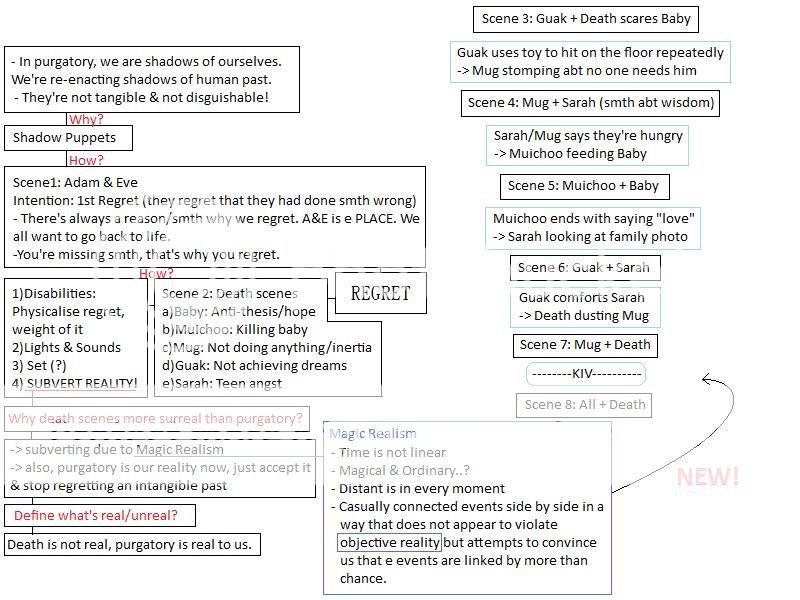
Click on image to enlarge and see clearly.
Next meeting on SATURDAY 13th March, 8.30AM-10.30AM @ Blackbox (?)
Tuesday, March 9, 2010
Meeting 8th March 2010
Location: Yellow Box
Agenda: Improv scene 1 to 7 with new set (movable beds)
Attendence: Full and on time.
Pointers:
1) Baby needs to have a more grotesque and stiff physicality+ innocent voice needs to juxtapose phy
2) Mug- Work on the old man walk, esp when raising walking stick. + Needs to change lines to make sure he is understood and has some sort of layers to his character.
3) Gwak- She transforms herself to fit the role that she wasnts to play + Her actions, walk, talk are all exaggerated and are greatly affected by her mood.
Changes:
1) Interaction scene is no longer in a straight line, revert back to horseshoe.
2) Position of tables during death scenes (in order)
Baby- Baby bed centre stage + Death desk behind, stage right
Mui Choo- Beds in an I, horizontal back and front are the waves.
Mug- No beds
Gwak- No beds
Sarah- All beds in a horseshoe.
DEADLINES:
Tuesday 9th March- Scripts memorized.
Wednesday 10th March- Subtext done.
3 days a week, Mark and Steph to work on physicality and voice for 30min, under supervision. Time slot to be allocated later.
Agenda: Improv scene 1 to 7 with new set (movable beds)
Attendence: Full and on time.
Pointers:
1) Baby needs to have a more grotesque and stiff physicality+ innocent voice needs to juxtapose phy
2) Mug- Work on the old man walk, esp when raising walking stick. + Needs to change lines to make sure he is understood and has some sort of layers to his character.
3) Gwak- She transforms herself to fit the role that she wasnts to play + Her actions, walk, talk are all exaggerated and are greatly affected by her mood.
Changes:
1) Interaction scene is no longer in a straight line, revert back to horseshoe.
2) Position of tables during death scenes (in order)
Baby- Baby bed centre stage + Death desk behind, stage right
Mui Choo- Beds in an I, horizontal back and front are the waves.
Mug- No beds
Gwak- No beds
Sarah- All beds in a horseshoe.
DEADLINES:
Tuesday 9th March- Scripts memorized.
Wednesday 10th March- Subtext done.
3 days a week, Mark and Steph to work on physicality and voice for 30min, under supervision. Time slot to be allocated later.
Monday, March 8, 2010
Sound
Sound is a complicated thing to explain. It's both music and the non-musicality of music at the same time. It's both sound and the inherent beat and rhythm in it. It is the atmosphere and the melody of the atmosphere at the same time.
I think we need to think of a main atmosphere we want for the entire piece so that the soundscape can cohesively come together. I was actually thinking that because we are in the hospital, the sound would be sparse, almost dry but still with it's hint of depth. This plays up the sterility of the situation of the hospital ward, and everything seems to strike at us with the strident cleanliness almost blinding us. The drawback is that it does not say much about the characters.
However, if we want to play up the depth of the music and make sound an integral part, I also have a couple of ideas as well. Using very layered music helps brings out different textures for each character. I'll let you guys listen to some of the stuff by Sigur Ros and the like. I think we can work around that soundscape. Their music/sound is very layered, non-structured, and sometimes almost dream-like. We are in the air with their music.
Another one is Animal Collective or something along those lines. Their music is incredibly visual and industrial. The fast pace could help create a sense of industriality to the production. We can also play around with the beat etc. However, I'm still not sure if it's exactly applicable since most of their music is also in a major key. i.e. It's pretty happy music.
The other option is to really have a chorus of noises. Whispers, grinding of machines, echoes, reverberating tones, ECG pulses, beeping machines, the wind etc. It's difficult but it's the most flexible. However, the danger is that we do not let it shape our performance. It becomes an IT thing that is just there to fill in empty gaps. I believe the sounds should push us, prompt us in some way for our actions and the way we are.
Just a couple of thoughts here.
I think we need to think of a main atmosphere we want for the entire piece so that the soundscape can cohesively come together. I was actually thinking that because we are in the hospital, the sound would be sparse, almost dry but still with it's hint of depth. This plays up the sterility of the situation of the hospital ward, and everything seems to strike at us with the strident cleanliness almost blinding us. The drawback is that it does not say much about the characters.
However, if we want to play up the depth of the music and make sound an integral part, I also have a couple of ideas as well. Using very layered music helps brings out different textures for each character. I'll let you guys listen to some of the stuff by Sigur Ros and the like. I think we can work around that soundscape. Their music/sound is very layered, non-structured, and sometimes almost dream-like. We are in the air with their music.
Another one is Animal Collective or something along those lines. Their music is incredibly visual and industrial. The fast pace could help create a sense of industriality to the production. We can also play around with the beat etc. However, I'm still not sure if it's exactly applicable since most of their music is also in a major key. i.e. It's pretty happy music.
The other option is to really have a chorus of noises. Whispers, grinding of machines, echoes, reverberating tones, ECG pulses, beeping machines, the wind etc. It's difficult but it's the most flexible. However, the danger is that we do not let it shape our performance. It becomes an IT thing that is just there to fill in empty gaps. I believe the sounds should push us, prompt us in some way for our actions and the way we are.
Just a couple of thoughts here.
Sunday, March 7, 2010
Baby reanalysis
Function of Character
In relation to DV, I have never experienced life before so I appreciate and want it so badly because I have lost it due to circumstance. Towards logical answers, I ask questions. Towards questions people try to logically solve, I give the most simplest answer. And I guess the simplest answers are the correct ones. My logic goes in line with fairytales, not with books. I have no chance to regret because I have not lived.
Why I am in purgatory - because of people like gwak who scares me about the world
Why I want to live - I want to see colours, feel the warmth of the sun, smell the flowers of spring and the morning dew on grass. I want to feel the breeze through my hair. I want to play with snowman and see all the beautiful things of the earth.
Revelation- Mug talks to me about life. That even though it can be sour, it is only with a mixture of tastes that makes it delicious and worth living for. So my fear of the bad things of living is gone and I even look forward to sour moments combined with the sweet things of life.
My take on each character
Sarah - She always seems uptight, like she's so close to looking for something but cannot grasp it. She has lots of books but none of them have pictures. I wonder what they are about. I think she can be my teacher since she has the most books from earth - which usually means she treasures them. Thus, i conclude that she must know and love knowledge. Which probably means she is the most knowledgeable.
Mui Choo - She is my mum. I seek her for motherly love because I have never experienced it before. She takes care of me and answers my questions. I wonder why she did not let her baby live. There are probably a lot of babies who don't get to live, like me. I think Mui Choo will know why. she said she was really scared to the point where she forgot to love. I cannot understand but maybe i will soon.
Death - He took me to where I am now. He is quite kind, he comforts me and tries to tell me why things happen. He is quite scary too. He just sits there and waits for us to make a decision on where to go so he can bring us.
Mug- He gets into nervous fits/ fits in general. Even though I do not know why he is like that, I know he is feeling bad and frustrated inside. So I comfort him sometimes. Although I feel that he is weird compared to the rest, he actually made me realise that life is nice not because it is sweet but because it has a mixture of flavours that makes it so rich.
Gwak - She is one scary person. She shouts half the time and scares me. I don't really believe her when she says that the world has no love, and is not worth living for. But there must be some truth to what she says, or else, why would she and EVERYBODY not want to live?
In relation to DV, I have never experienced life before so I appreciate and want it so badly because I have lost it due to circumstance. Towards logical answers, I ask questions. Towards questions people try to logically solve, I give the most simplest answer. And I guess the simplest answers are the correct ones. My logic goes in line with fairytales, not with books. I have no chance to regret because I have not lived.
Why I am in purgatory - because of people like gwak who scares me about the world
Why I want to live - I want to see colours, feel the warmth of the sun, smell the flowers of spring and the morning dew on grass. I want to feel the breeze through my hair. I want to play with snowman and see all the beautiful things of the earth.
Revelation- Mug talks to me about life. That even though it can be sour, it is only with a mixture of tastes that makes it delicious and worth living for. So my fear of the bad things of living is gone and I even look forward to sour moments combined with the sweet things of life.
My take on each character
Sarah - She always seems uptight, like she's so close to looking for something but cannot grasp it. She has lots of books but none of them have pictures. I wonder what they are about. I think she can be my teacher since she has the most books from earth - which usually means she treasures them. Thus, i conclude that she must know and love knowledge. Which probably means she is the most knowledgeable.
Mui Choo - She is my mum. I seek her for motherly love because I have never experienced it before. She takes care of me and answers my questions. I wonder why she did not let her baby live. There are probably a lot of babies who don't get to live, like me. I think Mui Choo will know why. she said she was really scared to the point where she forgot to love. I cannot understand but maybe i will soon.
Death - He took me to where I am now. He is quite kind, he comforts me and tries to tell me why things happen. He is quite scary too. He just sits there and waits for us to make a decision on where to go so he can bring us.
Mug- He gets into nervous fits/ fits in general. Even though I do not know why he is like that, I know he is feeling bad and frustrated inside. So I comfort him sometimes. Although I feel that he is weird compared to the rest, he actually made me realise that life is nice not because it is sweet but because it has a mixture of flavours that makes it so rich.
Gwak - She is one scary person. She shouts half the time and scares me. I don't really believe her when she says that the world has no love, and is not worth living for. But there must be some truth to what she says, or else, why would she and EVERYBODY not want to live?
New Character Analysis for Mug
Name: Mug
Age: 800 years
Occupation: (forgotten) God of Wisdom
Aim: To be worshiped and remembered.
Obvious characteristics: Self-centered, confused, forgotten, ignored. Stuck in the hunger to retain lost glory and dignity, to be worshipped again. Now powerless.
Background: I came to the earth as people of that time sought to find solace in life. People searched for wisdom as they flocked to the temples which at that time were high as the moon, the stars. People looked up to me, prayed to me, worshipped me. I was God. This all happened about 800 years ago when the world was still apart. When the gods didn't cross paths. I was God. The people fed me and I was what they lived for. I gave back. I imparted many pieces of advice and precautions to my worshippers. Then came these people from the west. People I've never seen before. People with skin which's colour was so sickly I wanted to comfort them and give them shelter. At first, they were students. People studying our ways, our life. People who studied me. Then they became teachers, then destroyers. They preached against me. Pointed fingers at me. Set fires on me. The land was no longer united and everything was crumbling. Before I knew it, the temples were desecrated. My treasures looted. Pillars were shattered. The foundations were gone. The people were separated. I fled. I crumbled. Here I am.
Regret: My one regret was that I let it slip from my hands. The power and glory I once had is now but a distant memory. The only prayers that come in come from schools. Exam halls. Youngsters searching for answers. Endlessly seeking. Yet it is knowledge they find. There is no wisdom. I regret letting wisdom die. Here in purgatory, I try to instill the wisdom into the people here. As I crumble further, I hope my final days will be fruitful, like the fig tree in the garden. If I can make at least one person feel wisdom for once again, and if I can make people worship the value of wisdom, I would be back. And I wouldnt crumble. Rather than being a wind-up toy people only use when they need to.
Realisation: I realise that perhaps I should just let go if it all. I'm not going to get my life of a God back. Maybe I'll make a bigger difference as a man.
Disability: As stated above, I need to be wound up. As I move, I lose control over parts of myself. I crumble. My movements are stacato, like all my joints are rusted and need a large amount of energy and force to move them. I use my walking stick as a means of getting around, having already lost the function of my left foot. As I diminish in importance and my usefulness dies, I become more and more dead. Until the next person winds me up, I'll forever be asleep.
Age: 800 years
Occupation: (forgotten) God of Wisdom
Aim: To be worshiped and remembered.
Obvious characteristics: Self-centered, confused, forgotten, ignored. Stuck in the hunger to retain lost glory and dignity, to be worshipped again. Now powerless.
Background: I came to the earth as people of that time sought to find solace in life. People searched for wisdom as they flocked to the temples which at that time were high as the moon, the stars. People looked up to me, prayed to me, worshipped me. I was God. This all happened about 800 years ago when the world was still apart. When the gods didn't cross paths. I was God. The people fed me and I was what they lived for. I gave back. I imparted many pieces of advice and precautions to my worshippers. Then came these people from the west. People I've never seen before. People with skin which's colour was so sickly I wanted to comfort them and give them shelter. At first, they were students. People studying our ways, our life. People who studied me. Then they became teachers, then destroyers. They preached against me. Pointed fingers at me. Set fires on me. The land was no longer united and everything was crumbling. Before I knew it, the temples were desecrated. My treasures looted. Pillars were shattered. The foundations were gone. The people were separated. I fled. I crumbled. Here I am.
Regret: My one regret was that I let it slip from my hands. The power and glory I once had is now but a distant memory. The only prayers that come in come from schools. Exam halls. Youngsters searching for answers. Endlessly seeking. Yet it is knowledge they find. There is no wisdom. I regret letting wisdom die. Here in purgatory, I try to instill the wisdom into the people here. As I crumble further, I hope my final days will be fruitful, like the fig tree in the garden. If I can make at least one person feel wisdom for once again, and if I can make people worship the value of wisdom, I would be back. And I wouldnt crumble. Rather than being a wind-up toy people only use when they need to.
Realisation: I realise that perhaps I should just let go if it all. I'm not going to get my life of a God back. Maybe I'll make a bigger difference as a man.
Disability: As stated above, I need to be wound up. As I move, I lose control over parts of myself. I crumble. My movements are stacato, like all my joints are rusted and need a large amount of energy and force to move them. I use my walking stick as a means of getting around, having already lost the function of my left foot. As I diminish in importance and my usefulness dies, I become more and more dead. Until the next person winds me up, I'll forever be asleep.
Meeting on 5th March
Location: School Black Box.
Time: 7 to 9 pm
Agenda: Practise scenes 1 to 7
Ask Miss N for comments
Improvements:
1) Beginning
- Up the energy
- Have one liner flashes from each character?
- Add soundscape
- Try Adam and Eve puppetry ASAP
- Think about WHAT the connection is bet the story of adam and eve and the play. They regretted leaving the place, not the actions they had performed. Is that what we are going to be playing on? Will our charcters be regreting leaving earth and not being able to live anymore or will they regret their actions and wrongdoings (the product of which was them leaving the world)?
2) Lights- For death scenes, MIX it with red light, don't make it completely red.
3) Rhythm- For the group as a whole, fr the individual, for the respective interaction scenes.
4) Set
- Beds now on wheels! Will be used to create the locations of the characters death scenes.
- No beds for death scenes?
- Use beds as prison, cliff, etc... for death scenes
- Bedsheets used as water for MC death scene?
5) Costume- Squishy shoes for Mui Choo
6) Physicality
-MC- Ask pregnant ladies WHERE they feel the aches and pains.
- Gwak- Don't fall into stereotypes (eg-crazy, bubbly). Look at neurological disorders or hyperactivity.
- Sarah- Add the disability of hanving hands tied to rods so cant fold them in EVER?
- Mug- Crubles when touched?
- Baby- roll all the time? never crawls?
HOMEWORK
1) Work on your physicality, practise it, do the necessary research and bring the props you need for the next session.
2) Contacts for set- Rachel, Mark and Steph, contact the ppl you have in your list. Get back to me on 9th (Tuesday)
3) Adam and Eve- Can we still use it? Does it have the same meaning our play is hoping to give?
4) Script- Any problems with it? Mug revise your part to make it deeper and more understandable.
5) Death scens- With the new set that we created, how would you like your death scene to be portrayed?
6) BRING a bedsheet and pillow for yourself, next rehersal.
Time: 7 to 9 pm
Agenda: Practise scenes 1 to 7
Ask Miss N for comments
Improvements:
1) Beginning
- Up the energy
- Have one liner flashes from each character?
- Add soundscape
- Try Adam and Eve puppetry ASAP
- Think about WHAT the connection is bet the story of adam and eve and the play. They regretted leaving the place, not the actions they had performed. Is that what we are going to be playing on? Will our charcters be regreting leaving earth and not being able to live anymore or will they regret their actions and wrongdoings (the product of which was them leaving the world)?
2) Lights- For death scenes, MIX it with red light, don't make it completely red.
3) Rhythm- For the group as a whole, fr the individual, for the respective interaction scenes.
4) Set
- Beds now on wheels! Will be used to create the locations of the characters death scenes.
- No beds for death scenes?
- Use beds as prison, cliff, etc... for death scenes
- Bedsheets used as water for MC death scene?
5) Costume- Squishy shoes for Mui Choo
6) Physicality
-MC- Ask pregnant ladies WHERE they feel the aches and pains.
- Gwak- Don't fall into stereotypes (eg-crazy, bubbly). Look at neurological disorders or hyperactivity.
- Sarah- Add the disability of hanving hands tied to rods so cant fold them in EVER?
- Mug- Crubles when touched?
- Baby- roll all the time? never crawls?
HOMEWORK
1) Work on your physicality, practise it, do the necessary research and bring the props you need for the next session.
2) Contacts for set- Rachel, Mark and Steph, contact the ppl you have in your list. Get back to me on 9th (Tuesday)
3) Adam and Eve- Can we still use it? Does it have the same meaning our play is hoping to give?
4) Script- Any problems with it? Mug revise your part to make it deeper and more understandable.
5) Death scens- With the new set that we created, how would you like your death scene to be portrayed?
6) BRING a bedsheet and pillow for yourself, next rehersal.
Tuesday, March 2, 2010
Sarah: Character Analysis
Name: Sarah
Occupation: Student JC2
Aim: Pursue a career in medicine.
Background: I was born into a very poor family, and as if two children weren’t enough, my mother had three more after me. My elder brother could not give a crap about working or providing for the family. I think it runs within the family because my father ran away from the family 8 years ago because he could not take the ‘pressure’. MY younger siblings are the least bothered with helping out at home, and seem to place my brother and father on pedestals as their role models. Very soon, I expect that they will be kicked out of school because they are just too rebellious and refuse to study. I tried to bring them up the right way, but tell me, how a teenager like me can raise three children in addition for having to provide for the home and take care of it too. I don’t have a mother, but in place of it I have a new sister, a very cynical, whiney, moody and lazy one at that! All my ‘mother’ does all day is sit and laze around at home. I try to get her jobs, but the next day she tells me that she’s been kicked out or that she just didn’t like it there! You think I like my life? NO! This is precisely why I ended it.
Personality: Surprisingly I’m not the angry rebellious type that some people would expect. I do get angry, but I keep it all inside me because it really would not make a difference if I voiced it out because no one gives a damn. I’m just too tired to be angry really. To tired to feel anything and too tired to do anything to make a change because I have tried so many times and failed over and over again.
Why I killed myself: My “A” level examinations were right around the corner and I was trying really hard to do well and try to secure a scholarship to go on to university. Just a few days before they began, my younger siblings contracted hand foot and mouth disease. We had no money for a doctor so I had to stay by their side night and day to monitor their situation and to try out every possible method I knew to cure them. Mother was busy at ‘work’, or at least that is what she claimed to be doing, and my brother decided that he needed money more desperately than I did, and so robbed me .LITERALLY! That was IT! There was no way I could get a scholarship, no way that I could get a loan, no way that I could manage to pay for university, and no one I could talk or scream to. It was like I was a robot that no one cared about as long I performed my functions. I didn’t know what I had left to live for because I had no future. I didn’t want to grow up a bitter woman; neither did I want to grow up in that dump of a house with my so called ‘family’. Death seemed like the most welcoming option.
Why I chose to hang myself: Its really quite simple- I didn’t have money to buy pills or drugs, and I didn’t want to slit my wrists or cut myself because I don’t really welcome the sight of blood. Moreover, hanging is a 100% way of dying because there is almost no way of it failing on you. So there it is…
What I regret: Acting impulsively. I should have rationalized the situation and thought of the pros and cons and the other possible options I had besides killing myself. I was just too overwhelmed with emotions that I could not think straight!
I regret not being able to fulfill the destiny that I had planned out for myself. I never reached the goal that I had worked my whole life to achieve. I was a failure, just like my mother and siblings. I was one of them and that disgusts me!
How do you show this regret?
My neck is a painful reminder of the stupid irrational mistake that I made. I can’t move it as I did before; I’m no longer in control. That’s a very odd position for me to be in and I’m still trying to get used to this handicap.
Do I get over my regret and move on?
No. I haven’t had the time to think about it. Yes, I still have the science student mind of rationalization, so every decision that I make must make sense. On one hand I do want to live again because I loved life, and who knows maybe this time ill get a better family! But I think at this point I’m just too scared of the unknown future, too scared to live again because the past and the mistakes that came along with it are just too fresh. I need more time to think, more time to lay out my options, and I think most importantly, I need time to heal the wounds that I came into purgatory with.
Occupation: Student JC2
Aim: Pursue a career in medicine.
Background: I was born into a very poor family, and as if two children weren’t enough, my mother had three more after me. My elder brother could not give a crap about working or providing for the family. I think it runs within the family because my father ran away from the family 8 years ago because he could not take the ‘pressure’. MY younger siblings are the least bothered with helping out at home, and seem to place my brother and father on pedestals as their role models. Very soon, I expect that they will be kicked out of school because they are just too rebellious and refuse to study. I tried to bring them up the right way, but tell me, how a teenager like me can raise three children in addition for having to provide for the home and take care of it too. I don’t have a mother, but in place of it I have a new sister, a very cynical, whiney, moody and lazy one at that! All my ‘mother’ does all day is sit and laze around at home. I try to get her jobs, but the next day she tells me that she’s been kicked out or that she just didn’t like it there! You think I like my life? NO! This is precisely why I ended it.
Personality: Surprisingly I’m not the angry rebellious type that some people would expect. I do get angry, but I keep it all inside me because it really would not make a difference if I voiced it out because no one gives a damn. I’m just too tired to be angry really. To tired to feel anything and too tired to do anything to make a change because I have tried so many times and failed over and over again.
Why I killed myself: My “A” level examinations were right around the corner and I was trying really hard to do well and try to secure a scholarship to go on to university. Just a few days before they began, my younger siblings contracted hand foot and mouth disease. We had no money for a doctor so I had to stay by their side night and day to monitor their situation and to try out every possible method I knew to cure them. Mother was busy at ‘work’, or at least that is what she claimed to be doing, and my brother decided that he needed money more desperately than I did, and so robbed me .LITERALLY! That was IT! There was no way I could get a scholarship, no way that I could get a loan, no way that I could manage to pay for university, and no one I could talk or scream to. It was like I was a robot that no one cared about as long I performed my functions. I didn’t know what I had left to live for because I had no future. I didn’t want to grow up a bitter woman; neither did I want to grow up in that dump of a house with my so called ‘family’. Death seemed like the most welcoming option.
Why I chose to hang myself: Its really quite simple- I didn’t have money to buy pills or drugs, and I didn’t want to slit my wrists or cut myself because I don’t really welcome the sight of blood. Moreover, hanging is a 100% way of dying because there is almost no way of it failing on you. So there it is…
What I regret: Acting impulsively. I should have rationalized the situation and thought of the pros and cons and the other possible options I had besides killing myself. I was just too overwhelmed with emotions that I could not think straight!
I regret not being able to fulfill the destiny that I had planned out for myself. I never reached the goal that I had worked my whole life to achieve. I was a failure, just like my mother and siblings. I was one of them and that disgusts me!
How do you show this regret?
My neck is a painful reminder of the stupid irrational mistake that I made. I can’t move it as I did before; I’m no longer in control. That’s a very odd position for me to be in and I’m still trying to get used to this handicap.
Do I get over my regret and move on?
No. I haven’t had the time to think about it. Yes, I still have the science student mind of rationalization, so every decision that I make must make sense. On one hand I do want to live again because I loved life, and who knows maybe this time ill get a better family! But I think at this point I’m just too scared of the unknown future, too scared to live again because the past and the mistakes that came along with it are just too fresh. I need more time to think, more time to lay out my options, and I think most importantly, I need time to heal the wounds that I came into purgatory with.
Monday, March 1, 2010
GUAKAWAKAWEENA'S RE-analysis
Name: GUAKAWAKAWEENA
Ambition: Famous Painter
Occupation: ARTS student
How did you die: i chopped off my right hand and i bleed to death
Family r/ship: Not supportive mom and dad. no siblings. i was a lonely person who had no one to talk to and no one to get advice from. i thought the world was bleak, cause my parents refused to talk or give me money to further my dream.
Friends: people around me always thought i was an oddball so i guess they kept a distance and i had not immediate close friends. the person i loved most, who encouraged me in my dreams was my grandmother, but she died 2 weeks before i did. i guess after her support ended, i also had nothing to live for.
Personality: i want to catch people's attention so naturally, i'm a loud person. i like to emulate artsy people who are flamboyant in their speaking and mannerism. also, i try to get along with everyone so i can have more friends. i keep my feelings to myself and i don't like to confide in people, yes, i know, trust issues. i like to explode because of all the suppressed emotions.
What exactly do you regret?
1) Killing myself. it was not my intention to kill myself when i cut off my hand, i just wanted to get rid of the one thing that constantly hounds at me and makes me feel inferior and insignificant. i bled to death before i knew it.
2) My dream was to be a famous painter and have all my artwork published in recognised museums all over the world. in my quest for this however, i was faced with many obstacles, my parents and friends were adamant that i go to the science stream as they thought they'll be a better future for me there. as a result, i had no support for my aspirations and people all around me were pressuring me to quit something i loved a lot. i coundn't handle the stress and all the rejection letters sent to me i killed myself. i regret that i had not pesevered and lived to see my goals achieved.
How do you show this regret?
Physicality- Missing right arm. When i move my right arm, i am overcome with pain, a constant reminder of what i was missing. i forget at times that my right hand is gone and numerous attempts were made to paint and do normal and daily stuff with my right hand, to comic failure. as a result, i am forced to stumble/fumble around with my left hand. my painting is also now ugly and i feel angry at myself all the time.
Object- A special paintbrush that i keep with me at all times to remind me of all the things that i had miss because of my foolish deed.
Character- Outgoing facade to hide the anger at myself for doing somwthing that i will regret forever. i seem to hate living because it reminds me of all the things i had forgone.
What is your realization? What triggers it?
I guess all the time i spend in purgatory has made me think about my actions and how i could have done something better, instead of killikng myself. however, i don't want to move on because i'm scared that i will still be deformed, that i can't paint, i'm sacred of life and i don't want to live again, the anger is still there, as well as the hunger, which i can't seem to satisfy.
The trigger is baby and sarah. i had scared baby of life but the way that baby is so determined to live is something that touched my heart. i considered living again too, or moving on. When Sarah came, i did was instantly reminded of myself, because we are so close in age. i come to realise that you know, i did have a choice, i don't want to live here forever, not being, not satisfied, not full. a bad life is better than a screwed up death.
What is this new thing that you want?
I want to live again. i want to be able to paint, i want to be full.
How are you going to get it?
Take a leap of faith, stop staying here, in limbo. Follow where Death takes me and hope to GOD i remeber my mistakles so i don't make them again.
What are the changes you undergo after this realization?
i guess the determination and courage to seek the unknown, to move on. i am not weight down and scared of my disability anymore. i embrace it and hope for the best. i also am not so fake happy anymore because now i have a purpose, a direction in life. i hope to convince the rest of them to move on too. not stay here and remain hungry.
Do you get rid of your handicap? How? What is your handicap?
Not being able to use my right hand. i guess after all this, i have come not to hate it, maybe to see it as a scar that i would proudly wear, embrace the fatc that i cannot use it again. it does not heal when i'm in purgatory though, i hope in my new life, or wherever i'm going, i will remember and appreaciate my hand and go for my dreams, be it with support or not. it is important to believe in myself and persevere.
Can you make you handicap more grotesque?
Yes. Blood veins all around my amputated arm, with blood spilling out of it whenever i try to move it. because i lost a lot of blood, also, my face can be sheet white and pale to the point of ghostly.
Ambition: Famous Painter
Occupation: ARTS student
How did you die: i chopped off my right hand and i bleed to death
Family r/ship: Not supportive mom and dad. no siblings. i was a lonely person who had no one to talk to and no one to get advice from. i thought the world was bleak, cause my parents refused to talk or give me money to further my dream.
Friends: people around me always thought i was an oddball so i guess they kept a distance and i had not immediate close friends. the person i loved most, who encouraged me in my dreams was my grandmother, but she died 2 weeks before i did. i guess after her support ended, i also had nothing to live for.
Personality: i want to catch people's attention so naturally, i'm a loud person. i like to emulate artsy people who are flamboyant in their speaking and mannerism. also, i try to get along with everyone so i can have more friends. i keep my feelings to myself and i don't like to confide in people, yes, i know, trust issues. i like to explode because of all the suppressed emotions.
What exactly do you regret?
1) Killing myself. it was not my intention to kill myself when i cut off my hand, i just wanted to get rid of the one thing that constantly hounds at me and makes me feel inferior and insignificant. i bled to death before i knew it.
2) My dream was to be a famous painter and have all my artwork published in recognised museums all over the world. in my quest for this however, i was faced with many obstacles, my parents and friends were adamant that i go to the science stream as they thought they'll be a better future for me there. as a result, i had no support for my aspirations and people all around me were pressuring me to quit something i loved a lot. i coundn't handle the stress and all the rejection letters sent to me i killed myself. i regret that i had not pesevered and lived to see my goals achieved.
How do you show this regret?
Physicality- Missing right arm. When i move my right arm, i am overcome with pain, a constant reminder of what i was missing. i forget at times that my right hand is gone and numerous attempts were made to paint and do normal and daily stuff with my right hand, to comic failure. as a result, i am forced to stumble/fumble around with my left hand. my painting is also now ugly and i feel angry at myself all the time.
Object- A special paintbrush that i keep with me at all times to remind me of all the things that i had miss because of my foolish deed.
Character- Outgoing facade to hide the anger at myself for doing somwthing that i will regret forever. i seem to hate living because it reminds me of all the things i had forgone.
What is your realization? What triggers it?
I guess all the time i spend in purgatory has made me think about my actions and how i could have done something better, instead of killikng myself. however, i don't want to move on because i'm scared that i will still be deformed, that i can't paint, i'm sacred of life and i don't want to live again, the anger is still there, as well as the hunger, which i can't seem to satisfy.
The trigger is baby and sarah. i had scared baby of life but the way that baby is so determined to live is something that touched my heart. i considered living again too, or moving on. When Sarah came, i did was instantly reminded of myself, because we are so close in age. i come to realise that you know, i did have a choice, i don't want to live here forever, not being, not satisfied, not full. a bad life is better than a screwed up death.
What is this new thing that you want?
I want to live again. i want to be able to paint, i want to be full.
How are you going to get it?
Take a leap of faith, stop staying here, in limbo. Follow where Death takes me and hope to GOD i remeber my mistakles so i don't make them again.
What are the changes you undergo after this realization?
i guess the determination and courage to seek the unknown, to move on. i am not weight down and scared of my disability anymore. i embrace it and hope for the best. i also am not so fake happy anymore because now i have a purpose, a direction in life. i hope to convince the rest of them to move on too. not stay here and remain hungry.
Do you get rid of your handicap? How? What is your handicap?
Not being able to use my right hand. i guess after all this, i have come not to hate it, maybe to see it as a scar that i would proudly wear, embrace the fatc that i cannot use it again. it does not heal when i'm in purgatory though, i hope in my new life, or wherever i'm going, i will remember and appreaciate my hand and go for my dreams, be it with support or not. it is important to believe in myself and persevere.
Can you make you handicap more grotesque?
Yes. Blood veins all around my amputated arm, with blood spilling out of it whenever i try to move it. because i lost a lot of blood, also, my face can be sheet white and pale to the point of ghostly.
New Character Analysis for Muichoo
Mui Choo
Age: 37 years old
D.O.Death: 1960s
Job: Pub waitress / Prostitute ("I work as waitress, but money also come from men. No time to marry. Some men don't mind who they sleep with.")
Obvious traits: Low educated. Simple minded / ignorant. Very Chinese-y. Hungry for love and escape and probably, second chances. Got abused by some of her customers but have to go with it. Got severely abused by her baby's dad.
New stuff about her:
I thought that I've found true love in the end but apparently, he turned out to be just another bastard. He got me pregnant and didn't want to marry me. When he's drunk, he will hit me and abuse me. Even when I'm pregnant, he forces me to have sex with him. He'll flirt and find other women in front of me. I've been with him for more than a year already. For the first few months, he was really sweet and gentle to me. I really thought that he might be different from all the other customers I've seen. He felt like he was the guy I once loved a long time ago, he reminded me of him. That's why I gave him a chance to get my love. In the end, he abused me till I had no choice but to kill myself. I can't bear to see my body with all those bruises and the baby that was created by him inside of me.
Why I regret:
I regret killing myself because I killed a baby, it's another new life that could have lived. I knew there were other methods of escaping that fate without having to kill myself. Also, who's left to take care of my sickly mother? My brother and sister are still young and incapable of providing for the family. What if my sister went to do what I did? I'll be harming her future! I had been irresponsible when I killed myself and I regret it.
Age: 37 years old
D.O.Death: 1960s
Job: Pub waitress / Prostitute ("I work as waitress, but money also come from men. No time to marry. Some men don't mind who they sleep with.")
Obvious traits: Low educated. Simple minded / ignorant. Very Chinese-y. Hungry for love and escape and probably, second chances. Got abused by some of her customers but have to go with it. Got severely abused by her baby's dad.
New stuff about her:
I thought that I've found true love in the end but apparently, he turned out to be just another bastard. He got me pregnant and didn't want to marry me. When he's drunk, he will hit me and abuse me. Even when I'm pregnant, he forces me to have sex with him. He'll flirt and find other women in front of me. I've been with him for more than a year already. For the first few months, he was really sweet and gentle to me. I really thought that he might be different from all the other customers I've seen. He felt like he was the guy I once loved a long time ago, he reminded me of him. That's why I gave him a chance to get my love. In the end, he abused me till I had no choice but to kill myself. I can't bear to see my body with all those bruises and the baby that was created by him inside of me.
Why I regret:
I regret killing myself because I killed a baby, it's another new life that could have lived. I knew there were other methods of escaping that fate without having to kill myself. Also, who's left to take care of my sickly mother? My brother and sister are still young and incapable of providing for the family. What if my sister went to do what I did? I'll be harming her future! I had been irresponsible when I killed myself and I regret it.
Updates for Muichoo
Regret
What do I exactly regret:
I regret killing myself - especially when I've got my baby inside. I regret giving up on life when I know that I can start afresh. I regret taking up this job because I cannot find true love with this kinda job.
How do I show it:
Script. Scenes where Muichoo communicates with Baby shows how regretful she is over killing herself and her baby. In the new scene with Guak & Sarah, Muichoo can show her regret by encouraging Guak & Sarah to move on and let go of their regret?
Actions. I always look/touch/hug Baby as if she's my own baby. I behave like I'm her Mamma.
Realization
My realization:
I realized that I shouldn't be held back by my regret and should live my life again.
The 'new' thing that I want:
True love. I want to start my own family. I want a proper life. I want to be a good Mamma. I want a loving husband.
After this realization, the changes I'll go through:
I'll become more optimistic? I'll encourage others to let go of their regret (S13 with Guak & Sarah) and tell them to be brave and move on! Things doesn't change unless you do something about it.
What do I exactly regret:
I regret killing myself - especially when I've got my baby inside. I regret giving up on life when I know that I can start afresh. I regret taking up this job because I cannot find true love with this kinda job.
How do I show it:
Script. Scenes where Muichoo communicates with Baby shows how regretful she is over killing herself and her baby. In the new scene with Guak & Sarah, Muichoo can show her regret by encouraging Guak & Sarah to move on and let go of their regret?
Actions. I always look/touch/hug Baby as if she's my own baby. I behave like I'm her Mamma.
Realization
My realization:
I realized that I shouldn't be held back by my regret and should live my life again.
The 'new' thing that I want:
True love. I want to start my own family. I want a proper life. I want to be a good Mamma. I want a loving husband.
After this realization, the changes I'll go through:
I'll become more optimistic? I'll encourage others to let go of their regret (S13 with Guak & Sarah) and tell them to be brave and move on! Things doesn't change unless you do something about it.
Disability
My disability:
I need to be wearing the hospital breathing mask all the time or else I will stop breathing and have spasms. When I take it off to speak, I'll have heavy breathing and it'll only last for 1 minute (?). Can include moments where I speak too much till I'm going to have spasms.
Do you get rid of your handicap?:
Possibly. Towards the end, I can speak for a longer time without much heavy breathing. It shows I've let go of my regret that used to be holding me back.
More grotesque?:
My looks? Smudged makeup with scars of being abused. But that's not really considered as disability. Maybe I can roll my eyes up when I'm having spasms, like as if I'm "possessed" :D
My disability:
I need to be wearing the hospital breathing mask all the time or else I will stop breathing and have spasms. When I take it off to speak, I'll have heavy breathing and it'll only last for 1 minute (?). Can include moments where I speak too much till I'm going to have spasms.
Do you get rid of your handicap?:
Possibly. Towards the end, I can speak for a longer time without much heavy breathing. It shows I've let go of my regret that used to be holding me back.
More grotesque?:
My looks? Smudged makeup with scars of being abused. But that's not really considered as disability. Maybe I can roll my eyes up when I'm having spasms, like as if I'm "possessed" :D
Sunday, February 28, 2010
New character analysis for Death + Disability stuff
Hi my name is Death. I am the person that governs the whole of purgatory and makes sure that there is order within this so called chaos. I also help to make sure that the needs of the people living in purgatory are taken care of. So therefore, I make sure that their bed sheets are cleaned, they have comfy pillows, they eat their medicine regularly and whenver they argue, I will stop their arguments with my powers. Furthermore, whenever a newcomer comes into purgatory, I have the duty to make sure that he or she will be able to settle in comfortably. I have a better relationship with the people that have been purgatory for a longer time. For example Mug etc. However ultimately, it is my wish for them to move on from purgatory, either to go to heaven, hell or to be reborn.
Regret
I regret my role and identity as Death. Being Death, I have witnessed many people coming into and leaving purgatory. While it comforts me to see people finally leave purgatory, it pains me because these people will have to die first before they are able to come here. Furthermore, a terrible fate awaits them if they go to hell afterwards, and if they choose to be reborn, all their memories will be erased. These people, especially those who want to be reborn, usually wants to make up for their mistakes. However, only I know that they never can. Therefore, since I am the one who ultimately grants them their decision, it pains me and thus I regret.
I guess to show this regret, it can be physicalised by being bounded in chains, to show how even though I regret being myself, I have no choice as I am still bounded and trapped in my role as Death.
Disability
I am blind. God made me blind so that during my time in purgatory, I will not be able to physically see the pain, regret, anger and sadness that the people are feeling. However, even though I'm blind, I can see better than any person. I can feel and "see" very clearly the emotions and desires of the poeple living in purgatory despite my disability. However, my blindness does it affect my movements and I still function as if I have perfect eyesight. I guess to physicalise this, I can wear the black shades that blind people usually wear, and even move around with the walking stick that blind people use. And when I finally remove my shades, we can make it more grotesque with the use of makeup. We can make my eyes look as if someone gouged it out.
P.S. I don't think I have a realization but rather more of a coming to terms with my role as Death with the help of Sarah or Mug. My disability is also never removed.
Regret
I regret my role and identity as Death. Being Death, I have witnessed many people coming into and leaving purgatory. While it comforts me to see people finally leave purgatory, it pains me because these people will have to die first before they are able to come here. Furthermore, a terrible fate awaits them if they go to hell afterwards, and if they choose to be reborn, all their memories will be erased. These people, especially those who want to be reborn, usually wants to make up for their mistakes. However, only I know that they never can. Therefore, since I am the one who ultimately grants them their decision, it pains me and thus I regret.
I guess to show this regret, it can be physicalised by being bounded in chains, to show how even though I regret being myself, I have no choice as I am still bounded and trapped in my role as Death.
Disability
I am blind. God made me blind so that during my time in purgatory, I will not be able to physically see the pain, regret, anger and sadness that the people are feeling. However, even though I'm blind, I can see better than any person. I can feel and "see" very clearly the emotions and desires of the poeple living in purgatory despite my disability. However, my blindness does it affect my movements and I still function as if I have perfect eyesight. I guess to physicalise this, I can wear the black shades that blind people usually wear, and even move around with the walking stick that blind people use. And when I finally remove my shades, we can make it more grotesque with the use of makeup. We can make my eyes look as if someone gouged it out.
P.S. I don't think I have a realization but rather more of a coming to terms with my role as Death with the help of Sarah or Mug. My disability is also never removed.
Subscribe to:
Comments (Atom)